

Get a quote for yourSTRUCTURE
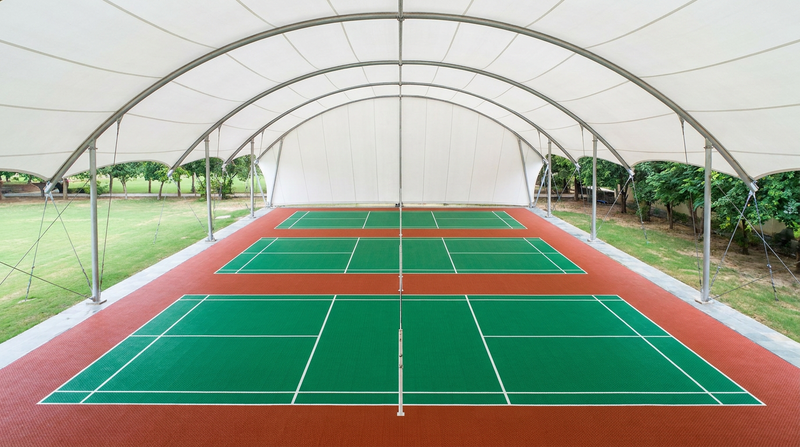
Tensile Roof Badminton Court
Turnkey StructureDesign, fabrication, and erection of sports structures, pan-India. Quoted turnkey with your court or standalone.
What you are actually buying — the full structure
Every element of the build documented — steel, roofing, foundations, and finishes.
-
Foundation
RCC footings + anchor pedestals
Sized for uplift, not just gravity load; anchor-bolt cages cast in
-
Structure
Steel columns + arches / masts
MS / GI hollow sections, painted or galvanised
-
Roof
Tensile membrane
PVDF-coated polyester class, 800-900 gsm range, patterned + heat-sealed
-
Tensioning
Cables + fittings
GI / SS cables, turnbuckles, edge clamps
-
Rainwater
Gutters + downtakes
Slope-designed shedding, no ponding zones
-
Sides
Optional mesh / windbreak sides
HDPE mesh or fabric drops
-
Lighting interface
Fixture mounts on steel
Between-court rows, anti-glare aiming
-
Service
Design + fabrication + installation
Wind design basis IS 875; engineered patterning
What it costs — and what costs extra
We publish indicative ranges so you can budget honestly. GST at 18% applies to all quotes.
Technical specifications
| Specification | Value |
|---|---|
| Membrane | PVDF-coated polyester, 800-900 gsm class, patterned + heat-sealed |
| Structure steel | MS / GI hollow sections, painted or galvanised, on RCC footings |
| Wind design basis | IS 875 (Part 3) for the site wind zone — uplift-governed |
| Clear height ladder | 9 m national / 7.6-9 m academy / 7 m recreational (measured at eave, not apex) |
| Membrane life | 10-15 years (re-skinnable over the same steel) |
| Steel life | Decades with intact coating |
| Side options | Open, HDPE mesh, or fabric windbreak drops (retrofittable) |
Is this structure right for you?
Best for
- Schools
- Society
- Pay and play
- Academies
- Multi sport
Note
This surface is acceptable but not recommended for:
- Fully enclosed ac halls
- Competition grade enclosed play
Talk to us — we'll honestly advise the right fit for your site.
Our recommendations are based on structural standards and our installation experience. We'd rather lose a sale than build the wrong structure.
Updated August 2026 · All structure prices on this page are indicative bands, ex-GST. Final rates come on an itemised estimate after a site and wind-zone review.
A tensile roof badminton court uses a fabric membrane canopy on steel columns to cover courts at lower cost than a full PEB hall — suited to schools, societies and pay-and-play venues that need rain and sun protection with open or mesh sides. Height clearance and wind-load design decide whether the covered court is genuinely playable.
- Membrane: PVDF-coated polyester, 800–900 gsm class, patterned and heat-sealed on site
- Structure: steel columns with arches or masts on RCC footings sized for wind uplift, not just gravity
- Clear height ladder: 9 m national · 7.6–9 m academy · 7 m recreational (apex vs eave explained below)
- Sides: open, or HDPE mesh / fabric windbreak drops to cut shuttle drift
- Indicative band: ₹600/sqft ex-GST for tensile (truss from ₹420, PEB up to ₹1,000)

What exactly are you buying? The tensile canopy build stack
A tensile roof is an engineered structure, not a tent, and the difference lives in the layers below. Every element appears on our estimate as its own line, not one mystery number. This is the full stack:
| Layer | Item | Specification | Why it matters |
|---|---|---|---|
| Foundation | RCC footings + anchor pedestals | Sized for uplift, not just gravity load; anchor-bolt cages cast in | Tensile roofs pull UP in wind — anchorage is the safety line |
| Structure | Steel columns + arches / masts | MS or GI hollow sections, painted or galvanised | Carries the membrane geometry over the courts |
| Roof | Tensile membrane | PVDF-coated polyester, 800–900 gsm class, patterned + heat-sealed | Rain + UV shield; translucency gives daytime light |
| Tensioning | Cables + fittings | GI / SS cables, turnbuckles, edge clamps | Keeps the membrane drum-tight — flutter destroys fabric |
| Rainwater | Gutters + downtakes | Slope-designed shedding, no ponding zones | Monsoon behaviour decides membrane life |
| Sides | Optional mesh / windbreak drops | HDPE mesh or fabric panels along open faces | Cuts wind drift on the shuttle without full-enclosure cost |
| Lighting interface | Fixture mounts on canopy steel | Between-court rows, anti-glare aiming | Implements the lights-between-courts rule |
| Service | Design + fabrication + installation | Wind design basis IS 875; engineered patterning | Engineered, accountable end to end — not a tent |
What is NOT included in the structure price: court flooring and equipment (see PVC court mats and wooden courts), lighting fixtures (an itemised add-on), civil work beyond the footings, land and approvals. GST 18% is extra and always stated.
Tensile roof cost per sqft — and why a cheap canopy can be unplayable
Covered-court structures run on three tracks. All figures are indicative ex-GST bands for the structure only — courts, lighting and electrical are itemised separately, never bundle-blurred:
| Structure type | Indicative band (₹/sqft, ex-GST) | What the number covers |
|---|---|---|
| Fabricated steel truss | ₹420 | Site-fabricated truss with sheeting — the budget covered-court route |
| Tensile roof (this page) | ₹600 | PVDF membrane on engineered steel masts / arches, tensioned, with rainwater design |
| PEB hall | ₹1,000 | Engineered clear-span frames, full sheeting and cladding, design basis included |
Why the spread — and why the ₹100–150/sqft “tent” quotes are not a structure
Those cheap “canopy” listings cover a tarpaulin over a minimal frame — no uplift-designed foundations, engineered steel or wind-load liability — so in an open field one becomes a hazard in the first serious storm. A real tensile structure sits in the ₹600 band, and the spread inside it comes from five levers:
- Clear span. Spanning two courts column-free needs heavier masts and cables than dropping a support between courts — but a column near play is a permanent hazard, so span is a spec, not a saving.
- Membrane grade. An 800 gsm PVDF-coated polyester behaves very differently from thin PVC sheet on weathering, self-cleaning and tear strength — grade is the biggest driver of membrane life.
- Height. Steel tonnage climbs with apex and eave heights — a 9 m national canopy carries more steel per sqft than a 7 m recreational one.
- Side treatment. Fully open is cheapest; mesh or fabric windbreak drops add cost but make an open-sided court playable in wind.
- Wind zone. Design wind speed per IS 875 varies by city; coastal and high-wind sites carry heavier anchorage and stronger cables.
Included vs extra — read this before comparing quotes
- Included in ₹/sqft: foundation design coordination, steel columns and arches, tensioned membrane, cables and fittings, rainwater gutters, erection and engineering drawings.
- Itemised extras: court flooring (PVC mat or wooden systems, per court), lighting packages (broadly ₹0.75–3.5 lakh per court by lux tier — see the full cost guide), side mesh, interior slab, electricals and approvals.
Which buyer is a tensile roof right for — and when it is not
Tensile beats a PEB hall on budget, speed and daylight; PEB beats it on full enclosure, climate control and competition-grade play. The honest sort:
| Buyer | Typical config | Tensile wins when… | Choose PEB / enclosure instead when… |
|---|---|---|---|
| School | 2–3 courts, 7–7.6 m | Budget rain-and-sun cover for PE; fast roof-over of an existing slab | The hall must double as an enclosed, AC-ready assembly space |
| Residential society | 2 courts, 7 m | Aesthetics and daylight matter; mesh sides accept the open look | Neighbours need full sound and light containment for late play |
| Pay-and-play centre | 3–4 courts, 9 m | Speed to revenue and a striking canopy; mesh sides control wind | Year-round monsoon operation needs a sealed, climate-controlled envelope |
| Coaching academy | 4–6 courts, 7.6–9 m | A phase-one covered facility before a full hall | Serious competition training needs a fully enclosed, draft-free hall |
The line that decides it: open-sided courts let wind affect shuttle flight. A shuttlecock is the lightest projectile in mainstream sport, so even a mild cross-draft skews the game. Mesh-sided canopies suit casual and school play; competitive or coaching play needs full side enclosure or a PEB hall — we say this before you buy, not after. Converting a building instead? Our indoor badminton court construction page uses the same height and lighting rules.
How long a tensile roof lasts — and what upkeep it needs
A tensile structure has two lifecycles. The steel is the long-life asset: columns and masts with an intact galvanised coating serve decades without repainting. The membrane is the consumable layer — a quality PVDF-coated polyester sits in the 10–15 year class before its coating chalks and translucency drops, then re-skins over the same steel at a fraction of a new structure. Cheap PVC sheet degrades in a few monsoons.
| Item | Cadence | What gets done |
|---|---|---|
| Membrane cleaning | Twice a year | Soft-wash the fabric; PVDF self-cleans in rain but grime shortens translucency |
| Cable re-tensioning | Yearly, pre-monsoon | Check turnbuckles and edge clamps; a slack membrane flutters and tears itself |
| Gutters + downtakes | Yearly, pre-monsoon | Clear debris so water sheds fast; ponding is the enemy of membrane life |
| Steel + anchors | Every 3–5 years | Inspect anchor bolts; spot-repair coating on painted steel before rust starts |
| Membrane replacement | Every 10–15 years | Re-skin the same steel frame — only the fabric is renewed |
The quiet advantage is UV: a PVDF membrane blocks the sun's heat and glare while passing soft daylight, so daytime play often needs no electric lighting. Inside the canopy, the court runs on its own wear and recoating cycle, covered on the mat and wooden court pages — keeping the membrane taut and gutters clear protects that flooring investment.
How a tensile badminton canopy gets built — five stages
- Footing design and casting. A site and wind-zone review sizes the RCC footings for uplift, not just downward load. Anchor-bolt cages are cast into pedestals to a template so the steel bolts up true.
- Steel erection. Columns, arches or masts are fabricated off-site and erected on the cured anchors — the geometry that holds the membrane shape is set here, to drawings.
- Membrane patterning and tensioning. The fabric is cut to a computed pattern, heat-sealed into panels, hoisted, and pulled drum-tight with cables and turnbuckles — tension is what makes a membrane a structure, not a sail.
- Rainwater management. Gutters and downtakes are fitted to the designed slopes so every storm sheds clear of the footings, no ponding pockets on the fabric.
- Sides, lighting and handover. Optional mesh or windbreak drops go up, light rows mount between the court lines on the canopy steel, and the court build takes over under a weather-tight roof.
Steel is fabricated off-site while footings cure on-site, so a tensile canopy reaches a court-ready state faster than site-welded construction — that parallel workflow is where a membrane roof earns its speed.
Tensile turnkey vs local tent-fabricator vs PEB — an honest decision table
We build covered structures on more than one path, so this comparison is by buying path, not by brand name:
| Buying path | Indicative ₹/sqft (ex-GST) | Strengths | Watch-outs |
|---|---|---|---|
| Tensile turnkey (this page) | ₹600 | Engineered patterning, uplift-designed footings, architectural daylight, single accountability | Open sides need mesh for serious play; not a fully enclosed, AC-ready envelope |
| Local tent / tarpaulin fabricator | ₹100–150 (sheet scope only) | Cheapest temporary cover; fine for short-term shade over casual play | No wind-uplift engineering, no anchorage design, no membrane life — a storm risk over a permanent court |
| PEB hall | ₹1,000 | Full enclosure, longest clear spans, climate-control ready, competition-grade play | Highest upfront band; less daylight; overkill for a budget school cover — see the PEB hall page |
The real differentiator is wind-uplift engineering. Anyone can stretch fabric over poles; what separates a structure from a hazard is whether the foundations and cables hold the roof down when a storm tries to lift it — a calculation a tent-fabricator quote rarely carries. Ask any bidder, us included, for that design basis in writing; without it, you are being sold a sail, not a roof.
Span options and specifications

| Courts | Canopy footprint (m) | Canopy footprint (ft) | Covered area | Typical clear span |
|---|---|---|---|---|
| 1 (competition) | 17.4 × 10.1 m | 57 × 33 ft | ~1,881 sqft | 10 m (33 ft) |
| 1 (recreational min.) | 14.9 × 7.9 m | 49 × 26 ft | ~1,274 sqft | 7.9 m (26 ft) |
| 2 | 26 × 20 m | 85 × 66 ft | ~5,600 sqft | 20 m (66 ft) |
| 4 | 48 × 20 m | 157 × 66 ft | ~10,335 sqft | 20 m (66 ft) |
The per-court footprint ladder is not negotiable: 57 × 33 ft for competition comfort, 52 × 28 ft for club and academy play, 49 × 26 ft as the recreational minimum. Spacing follows the same discipline — never less than 2 ft to any obstacle, and a canopy column counts as an obstacle — so we span two courts column-free rather than drop a support into the run-off.
| Play tier | Clear height under canopy (m) | Clear height (ft) |
|---|---|---|
| National / state competition | 9 m | 30 ft |
| Academy training | 7.6–9 m | 25–30 ft |
| Recreational | 7 m | 23 ft |
| Below 6.7 m (22 ft) | Not recommended — we build below this line only with the buyer's written acknowledgement | |
The 9 m national tier aligns with the clear-height norms for BWF competition play. On a peaked membrane, apex and eave heights differ, and only the honest figure counts: clear height is measured at the eave, the lowest point over the court — not the tall apex. A canopy reading 9 m at the peak but 6 m at the eave is a 6 m court, so we quote the eave. Two locked rules follow: nothing may hang into that clear height over the court; and light fixture rows run between courts, never above them, mounted on canopy steel with anti-glare aiming so shuttle sightlines stay clean. The full lux ladder lives in our net size and court lighting guide.
Every canopy is designed to IS practice with wind loading per IS 875 for your site — coastal and high-wind locations get their own design run, not a copy-paste frame. Download the tensile roof span and spec sheet (PDF) for the full dimension set, or write to enquiry@champcourts.com for the editable version.
Frequently asked questions
What does a tensile roof for a badminton court cost per sqft?
Indicatively ₹600/sqft ex-GST for the tensile structure alone — uplift-designed footings, steel masts, tensioned PVDF membrane, cables and gutters. A budget truss runs ₹420 and a full PEB hall ₹1,000; court flooring, lighting and side mesh are itemised separately. “Tent” listings at ₹100–150/sqft cover sheet-fixing scope only, not an engineered roof. GST 18% is extra.
Tensile roof vs PEB shed — which is better for badminton?
Tensile wins on budget, speed and natural daylight, ideal for schools, societies and pay-and-play centres that accept open or mesh sides. PEB wins on full enclosure, climate control and competition-grade play, because it seals out wind and light. Choose PEB for year-round monsoon operation or serious competition; choose tensile for a fast, striking, cost-led cover.
How long does a tensile membrane last?
A quality PVDF-coated polyester membrane sits in the 10–15 year class before its coating chalks and translucency drops, at which point it is re-skinned over the same steel — a fraction of a new structure's cost. The steel columns and cables last decades. Cheap PVC tarpaulin degrades within a few monsoons, which is exactly why membrane grade drives the price spread.
Is a tensile roof safe in high wind?
Yes, when it is engineered for uplift. A tensile roof pulls upward in a storm, so the safety comes from foundations and cable anchorage designed to hold it down, per IS 875 wind loading for your zone. That calculation — not the fabric — separates a structure from a hazard. Always ask any bidder for the wind-uplift design basis in writing before signing.
Does a tensile roof handle heavy monsoon rain?
Yes, provided the rainwater is designed, not assumed. The membrane sheds water fast when kept drum-tight and sloped, with gutters and downtakes sized to clear the peak storm without ponding. Ponding — standing water in a slack pocket — is the biggest killer of membrane life, so pre-monsoon cable re-tensioning and gutter clearing are part of the yearly upkeep we hand over.
What height clearance do I get under a tensile roof?
Follow the ladder: 9 m clear for national and state play, 7.6–9 m for academy training, and 7 m for recreational courts; below 6.7 m we build only with written acknowledgement. On a peaked membrane, clear height is measured at the eave — the lowest point over the court — not the tall apex, and no cable or fixture may hang into it.
Can the sides of a tensile court be closed later?
Yes. A canopy can start open and add HDPE mesh or fabric windbreak drops later, or progress to full side enclosure as budget allows — the steel geometry accepts side fixings from day one. That makes tensile a natural phase-one structure: cover the courts now, cut wind drift with mesh next, and enclose fully if the venue turns competitive.
Get an itemised covered-court estimate
Tensile roof badminton canopies start from approximately ₹33.6 lakh ex-GST for a 2-court 26 × 20 m structure, ranging to about ₹62 lakh for a 4-court 48 × 20 m canopy — structure scope only, with court flooring, lighting and side mesh itemised separately and GST 18% shown on its own line. Share your plot dimensions, court count and city through the enquiry form, message us on WhatsApp (+91 92587 75187), or write to enquiry@champcourts.com. ChampCourts Private Limited builds pan-India from its Hyderabad headquarters (GSTIN 36AANCC6975A1ZG) — every quote arrives itemised, with the wind-uplift design basis in writing.
How long it lasts — and what upkeep really involves
How we build your structure — 6 steps
From site survey to handover — transparent at every stage.
Site survey & assessment
Our team visits, measures, and assesses soil, wind exposure, and access.
Design & engineering approval
You approve span, height, layout, and finish options before fabrication.
Foundation work
Footings and anchor bolts cast to the approved structural design.
Fabrication
Structural members fabricated to specification and finished for corrosion protection.
Erection & roofing
Framework erected, roofing and cladding installed with safety supervision.
Handover & warranty
Final inspection, walkthrough, warranty + maintenance docs handed over.
Project gallery
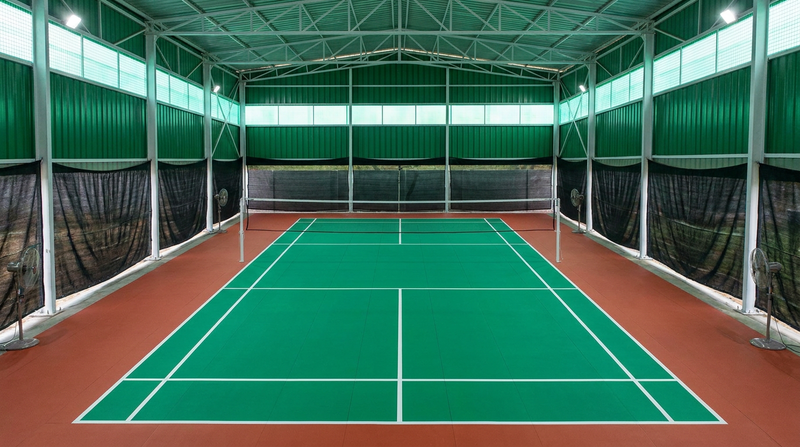
Structures we design and build across India.
Why ChampCourts
We're the installer, not just a material supplier.
Turnkey, not just supply
Design, foundations, fabrication, erection — we handle everything end-to-end.
Documented warranty
Warranty on structure and workmanship, documented and enforceable.
Pan-India service
Northeast to Bangalore — we travel where you build.
Transparent pricing
Real rates on every product page. No hidden cost, no surprises.
Frequently asked questions
Common questions about sports structures.
Indicatively Rs 600/sqft ex-GST for the tensile structure alone — uplift-designed footings, steel masts, tensioned PVDF membrane, cables and gutters. A budget truss runs Rs 420/sqft and a full PEB hall Rs 1,000/sqft; court flooring, lighting and side mesh are itemised separately. Tent listings at Rs 100-150/sqft cover sheet-fixing scope only, not an engineered roof. GST 18% is extra.
Tensile wins on budget, speed and natural daylight, ideal for schools, societies and pay-and-play centres that accept open or mesh sides. PEB wins on full enclosure, climate control and competition-grade play, because it seals out wind and light. Choose PEB for year-round monsoon operation or serious competition; choose tensile for a fast, striking, cost-led cover.
A quality PVDF-coated polyester membrane sits in the 10-15 year class before its coating chalks and translucency drops, at which point it is re-skinned over the same steel — a fraction of a new structure's cost. The steel columns and cables last decades. Cheap PVC tarpaulin degrades within a few monsoons, which is exactly why membrane grade drives the price spread.
Yes, when it is engineered for uplift. A tensile roof pulls upward in a storm, so the safety comes from foundations and cable anchorage designed to hold it down, per IS 875 wind loading for your zone. That calculation — not the fabric — separates a structure from a hazard. Always ask any bidder for the wind-uplift design basis in writing before signing.
Yes, provided the rainwater is designed, not assumed. The membrane sheds water fast when kept drum-tight and sloped, with gutters and downtakes sized to clear the peak storm without ponding. Ponding — standing water in a slack pocket — is the biggest killer of membrane life, so pre-monsoon cable re-tensioning and gutter clearing are part of the yearly upkeep we hand over.
Follow the ladder: 9 m clear for national and state play, 7.6-9 m for academy training, and 7 m for recreational courts; below 6.7 m we build only with written acknowledgement. On a peaked membrane, clear height is measured at the eave — the lowest point over the court — not the tall apex, and no cable or fixture may hang into it.
Yes. A tensile canopy can start open and add HDPE mesh or fabric windbreak drops later, or progress to full side enclosure as budget allows — the steel geometry is designed to accept side fixings from day one. That makes tensile a natural phase-one structure: cover the courts now, cut wind drift with mesh next, and enclose fully if the venue turns competitive.
Ready to cover your court?
Free site assessment within 48 hours. No commitment.
Prefer to call or WhatsApp?