

Get a free estimate for yourCOURT
Wooden Badminton Court Flooring
Turnkey InstallationTurnkey court construction, transparent pricing, and a free written quotation. Pan-India service.
Configure your court
Prices are indicative per sqft, ex-GST. Use the cost calculator below for a full project estimate including base, kerbs, line marking, and add-ons.
Calculate Your Court Cost
Pre-configured for this surface. Enter dimensions for an instant estimate — no signup required.
Which sport will this court be used for?
How many courts and what configuration?
What surface type do you want?
What is the base / sub-structure situation?
Any add-ons? (Optional — all can be added later)
Indicative range only. Actual pricing depends on site conditions, geography, and final material availability. Use the WhatsApp button to send your configuration directly to our team for a detailed estimate within 5 minutes.
Is this surface right for you?
Best for
- Competition halls
- Academies
- Clubs
- Tournament venues
Note
This surface is acceptable but not recommended for:
- Schools
- Recreational
- Outdoor
Talk to us — we'll honestly advise the right fit for your goals.
Our recommendations draw on each sport's court dimensions and line-marking rules and on the team's 16+ years of hands-on experience. No surface is one-size-fits-all — we'd rather lose a sale than build the wrong court.
Wooden Badminton Court Flooring — Air-Cushion Sprung System
Updated August 2026 · ChampCourts Private Limited · Hyderabad HQ · pan-India installation
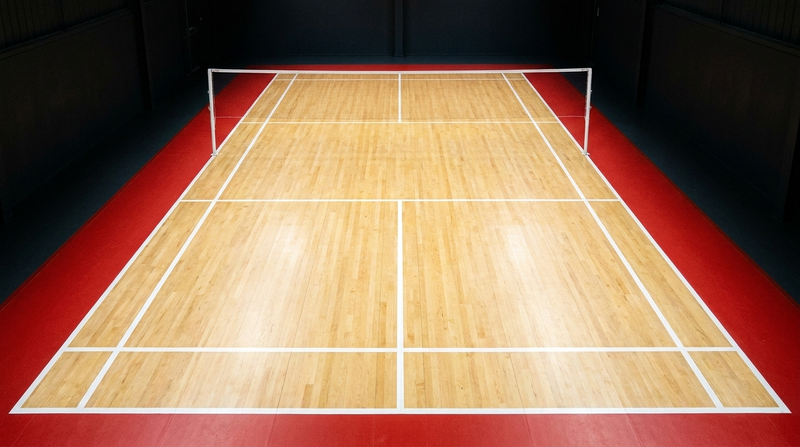
A wooden badminton court is an air-cushion sprung system: maple or teak strip flooring laid over elastomer pads and a plywood sub-floor, finished with anti-slip PU lacquer and 40 mm court lines. It is the surface of choice for premium academies and competition halls, installed per sqft on a moisture-checked slab.
- Species: hard maple or teak, tongue-and-groove strip flooring
- System build-up: 37 mm class, including a 20–22 mm timber wear layer
- Finish: multi-coat anti-slip PU sports lacquer, matte sheen
- Marking: 40 mm lines in two-part PU floor line paint, per BWF court dimensions
- Format: installed per sqft on your existing slab — indicative Rs 380–600/sqft ex-GST
- Service class: 20–25 year system life with periodic re-sanding cycles

Inside the air-cushion system — layer by layer
"Wooden flooring" sells as if the plank were the product. It is not. What you are actually buying is a sprung system: a grid of resilient elastomer pads that leaves an engineered air gap under the timber, so the floor compresses slightly on landing and returns energy on push-off. That cushion — not the wood species, not the lacquer — is what protects knees and ankles through a three-hour training session, and it is the difference between a sports floor and a stage. Every layer below exists to make that behaviour uniform across all 1,456 sqft of an academy court.
| Layer | Component | Specification | Why it matters |
|---|---|---|---|
| Substrate | Slab moisture + level verification | Moisture-tested PCC/RCC; flatness checked before work starts | Wood moves with moisture — this test prevents failure, and flatness keeps net height true |
| Moisture control | Vapour barrier membrane | PE film / bituminous layer, lapped and sealed | Blocks slab moisture from cupping the timber |
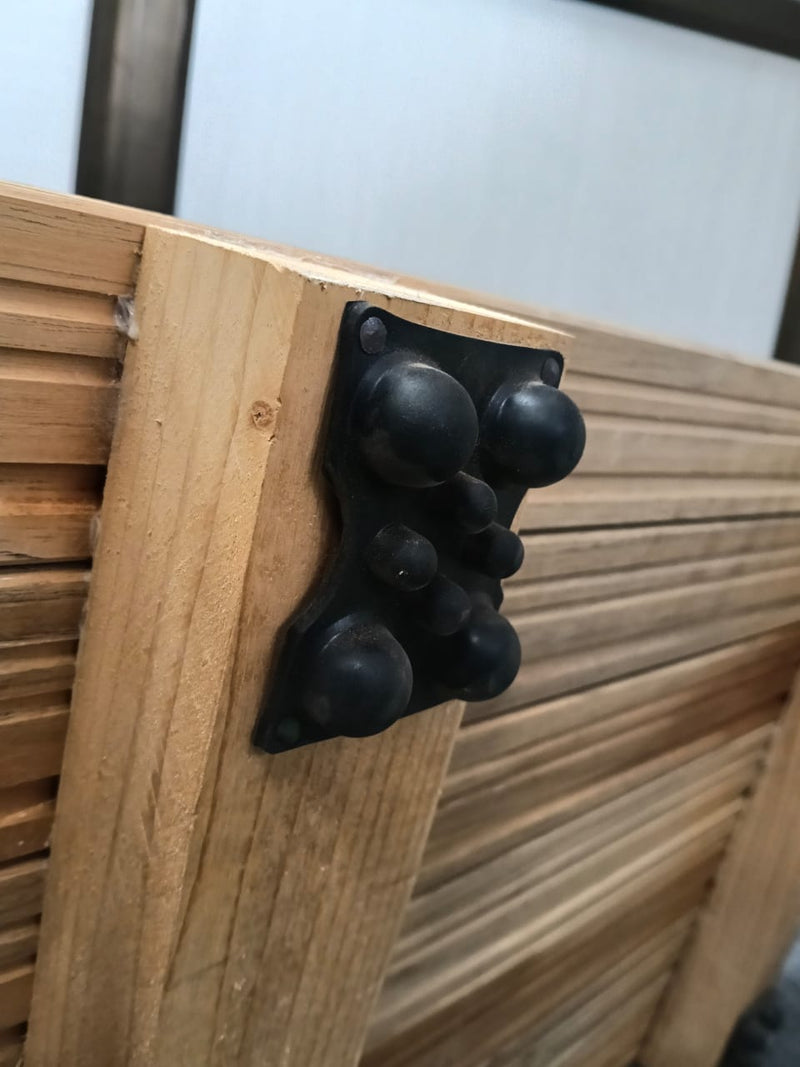
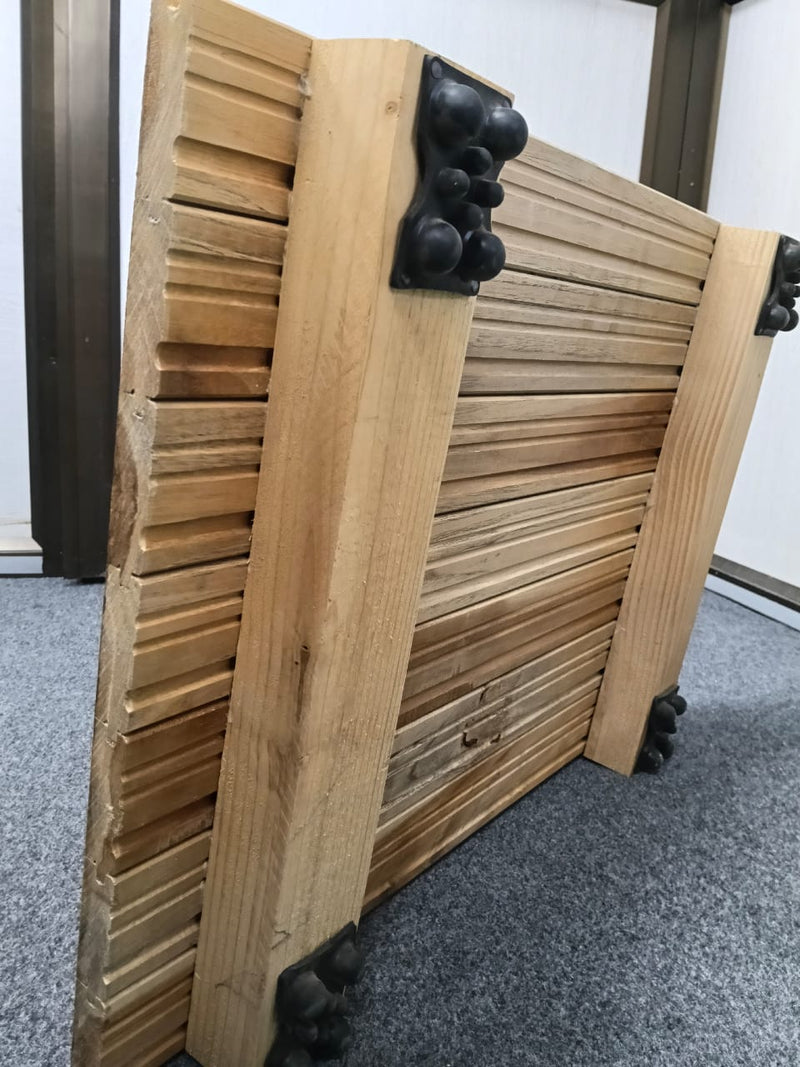
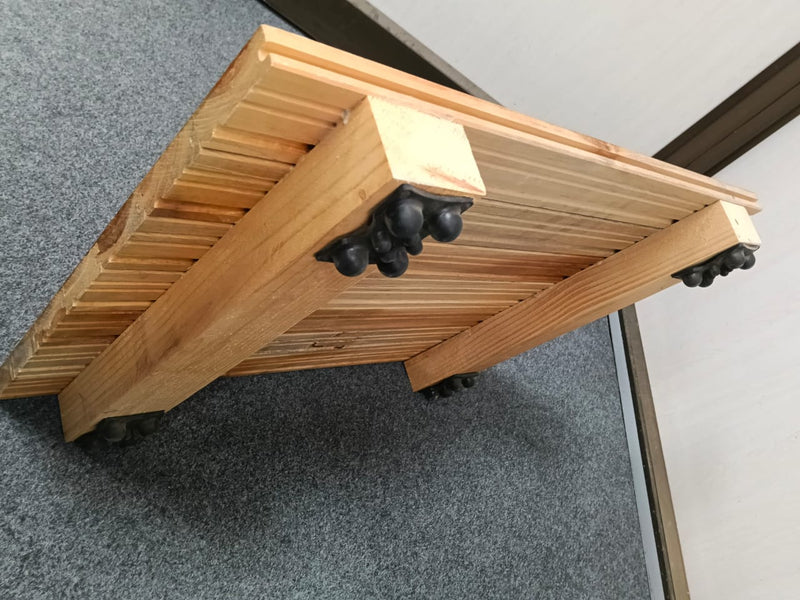
| Cushion | Elastomer pads (air-cushion) | Resilient pads set on a grid under the battens | Shock absorption — knee and ankle protection; the "sprung" in sprung floor |
| Sub-floor | Battens + plywood deck | Kiln-dried battens; structural ply with staggered joints | Distributes load so bounce feels identical everywhere on the court |
| Surface | Maple or teak strip flooring | T&G strips, ~20–22 mm wear layer; full build-up in the 37 mm class | The playing surface — hardness and grain suited to sport |
| Finish | PU sports lacquer | Anti-slip, matte sheen, multi-coat | Controlled friction; glare-free under hall lighting |
| Marking | Court lines | 40 mm two-part PU line paint, white or contrasting | Regulation singles + doubles marking |
| Equipment | Posts + net (floor-socket option) | 1.55 m posts on the doubles sideline; flush sockets for multi-use halls | Competition-ready, with a clear floor when not in play |

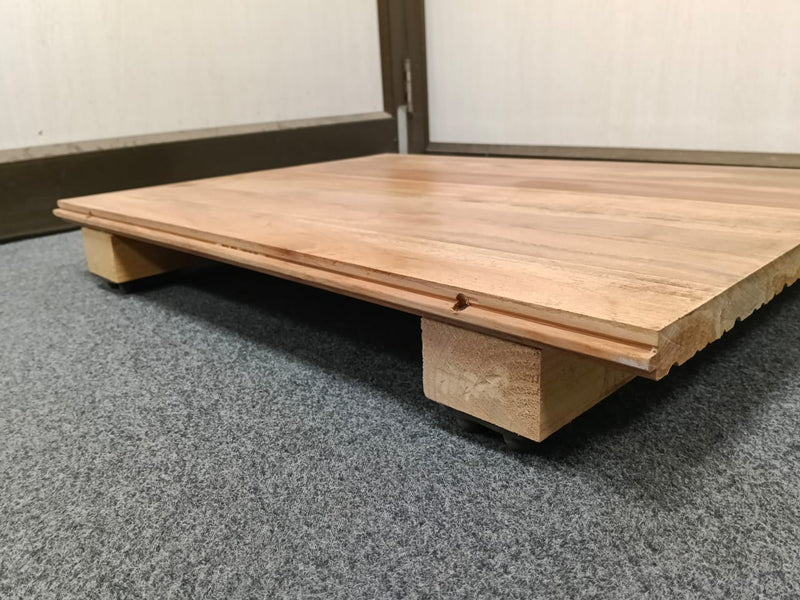
The same layers, photographed on a real system build:


Not included: hall structure, lighting, HVAC, divider curtains (available on the add-on menu), and slab construction. GST 18% extra on all figures.
What does a wooden badminton court cost per square foot?
A wooden badminton court installs at Rs 380–450 per sqft for a standard air-cushion sprung system and Rs 500–600 per sqft for a premium build to a competition-grade EN 14904 shock-absorption class — ex-GST, on your existing slab, with species, system depth, and finish grade driving the spread.
| Band | Indicative rate (ex-GST) | What it specifies |
|---|---|---|
| Standard | Rs 380–450/sqft | Air-cushion sprung system, maple or teak options, multi-coat PU finish, 40 mm lines |
| Premium | Rs 500–600/sqft | Competition-grade build (EN 14904 shock-absorption class) — deeper cushion grid, select-grade timber, competition finish schedule |
| Posts + net (add-on) | Rs 10–15k standard pair · Rs 28–45k tournament | Flush floor-socket systems available as a premium option for multi-use halls |
Why the price spread exists
- Species: teak typically carries a premium over maple, and grade within a species (select vs standard) moves the timber cost meaningfully.
- System depth: pad density and grid spacing, batten section, and ply grade — a deeper, denser cushion build costs more and plays better.
- Finish grade: the number of lacquer coats and the finish schedule (seal + top coats) separate a club finish from a competition one.
- Sockets and equipment: flush floor sockets are machined into the system — a premium line item, but the right call for halls that host other sports.
Worked example: a 52 × 28 ft academy footprint is 1,456 sqft, so the floor lands roughly between Rs 5.5 lakh (standard, lower band) and Rs 8.7 lakh (premium, upper band) before GST, posts, and net. For the full hall budget — structure, lighting, HVAC — see the badminton court construction cost guide.
All rates ex-GST; GST 18% extra. Final pricing is site-specific: slab condition, footprint, access, and specification all move the number, which is why we quote after a moisture and level check rather than from a rate card alone.
Is wood right for your hall? Suitability by buyer
| Buyer | Verdict | Why |
|---|---|---|
| Competition hall | The natural choice | BWF-grade construction class; the feel serious players expect; floor sockets keep it tournament-ready |
| Premium academy | Strong fit | Daily multi-hour load is exactly what the air-cushion layer is engineered for; 20–25 year system life amortises well |
| Club / community hall | Fit, with conditions | Justified if the hall is enclosed and humidity is managed; multi-sport use argues for flush sockets |
| School / recreational | Often over-spec | A PVC badminton mat delivers safe play at a fraction of the cost and moves with you — the honest recommendation for most school budgets |
Check the hall before the floor: clear height decides what level of play the venue can ever host. The ladder runs 12 m (39.4 ft) for BWF international play, 9 m (29.5 ft) for national events, 7.6–9 m (25–29.5 ft) for academy training, and 7 m (23 ft) as the recreational minimum. Planning the building as well as the floor? Start with indoor badminton court construction. Comparing surface families first? The badminton court flooring guide puts wood, vinyl, and acrylic side by side.
How long does it last — and what does upkeep involve?
A properly built air-cushion system sits in the 20–25 year service class — the longest-lived badminton surface you can buy, on one condition: the timber must stay dry and free to move. The wear layer is sanded back and re-lacquered every 5–8 years depending on traffic, with lines repainted after each cycle; a 20–22 mm strip has enough meat for several such cycles, which is where the lifetime economics beat thinner builds. When the finish dulls or lines wear ahead of schedule, that is a resurfacing job, not a replacement.
Humidity is the one genuine enemy. Timber swells in monsoon humidity and shrinks in dry, air-conditioned winters. The system is designed for this — vapour barrier below, expansion gaps at the perimeter — but coastal and monsoon-heavy cities should budget for humidity management (ventilation discipline at minimum, dehumidified air handling ideally) and lean towards teak, whose natural oils tolerate moisture swings better than maple.
- Daily: dust-mop; grit is the finish's main abrasive. Never wet-mop a wooden court.
- Weekly: barely-damp micro-fibre clean with a wood-floor product; check entry matting.
- Seasonally: watch hall humidity — a stable band around 35–65% RH keeps movement invisible; inspect expansion gaps and socket caps.
- Every 5–8 years: screen or full re-sand, re-lacquer, re-mark lines.
How we install it: slab test to handover
- Slab moisture and level test — the go/no-go gate. If the slab fails, we fix the slab problem first, not the symptom later.
- Vapour barrier — membrane laid, lapped, and sealed across the full footprint.
- Pad grid + battens — elastomer pads set out on the engineered grid; kiln-dried battens fixed over them.
- Plywood sub-floor — structural deck with staggered joints, screwed to the battens.
- Strip flooring — acclimatised maple or teak T&G strips laid with perimeter expansion gaps.
- Sanding and sealing — progressive-grit sanding to a flat, bare-timber surface, then seal coat.
- PU sports lacquer — multi-coat anti-slip finish, matte sheen, with cure time respected between coats.
- Line marking — 40 mm lines in two-part PU floor line paint to BWF court dimensions.
- Equipment and handover — posts and net (or flush sockets), final inspection, care guide handed over.
One planning note from the F1 rulebook: in multi-court halls, luminaires run between courts, never directly over them — a glare decision that gets locked before the floor goes in.
Three ways to buy a wooden court — and what goes wrong
| Buying path | What you get | Where it fails |
|---|---|---|
| Installed sprung system (single contractor) | Engineered build-up, moisture protocol, and workmanship accountability in one contract | Highest headline rate — you are paying for the system, the protocol, and a single throat to choke |
| Material-only timber supplier + your contractor | Good timber at a good rate — and you as the system integrator | Pad grid spacing, ply grade, and acclimatisation fall between two vendors; when bounce varies across the court, nobody owns it |
| Local carpenter build | The cheapest quote, built like interior flooring | The classic failures: no vapour barrier (cupping), no expansion gap (buckling in the first monsoon), non-kiln-dried battens (squeaks and movement), decorative gloss PU instead of anti-slip sports lacquer (wrong friction, real injury risk) |
The pattern in failed wooden courts is always the same: the visible layer was fine and the invisible layers were skipped. Whoever you buy from, make the quote itemise the vapour barrier, the pad grid, the expansion detail, and the lacquer system by name — a supplier who cannot itemise them is not building a sprung floor.
Specifications — 37 mm class systems vs 21 mm claims
Listings quoting "21 mm wooden flooring" usually describe the strip alone, or a thin glue-down build with no true cushion layer. A genuine air-cushion system is specified by its full build-up and its behaviour underfoot — EN 14904, the European sports-flooring standard, classifies indoor surfaces by shock absorption, vertical deformation, and ball behaviour, which is the right lens for comparing quotes.
| Build-up component | Typical contribution |
|---|---|
| Timber wear layer (maple/teak strip) | ~20–22 mm (0.8–0.9 in) |
| Structural plywood deck | ~9–12 mm (0.35–0.5 in) |
| Battens + elastomer pad grid | Balance of the system height |
| Full system class | 37 mm class (~1.5 in) total build-up |
Teak vs maple at a glance
| Property | Hard maple | Teak |
|---|---|---|
| Hardness (Janka) | ~1,450 lbf — harder, resists dents | ~1,000–1,100 lbf |
| Tone and grain | Light, tight-grained — shuttle and lines read clearly | Warm golden-brown, pronounced grain |
| Moisture behaviour | Prefers stable, conditioned halls | Natural oils — the more forgiving species in humid climates |
| Best for | Competition halls, climate-controlled academies | Coastal and monsoon-heavy cities, unconditioned halls |
Hall footprint ladder (per court)
| Footprint | Feet | Metres | Area |
|---|---|---|---|
| Competition | 57 × 33 ft | 17.4 × 10.1 m | 1,881 sqft (174.8 sqm) |
| Academy | 52 × 28 ft | 15.8 × 8.5 m | 1,456 sqft (135.3 sqm) |
| Compact | 49 × 26 ft | 14.9 × 7.9 m | 1,274 sqft (118.4 sqm) |
| BWF court core | 44 × 20 ft | 13.4 × 6.1 m | 880 sqft (81.7 sqm) |
Rule of thumb that never bends: no point on the court closer than 2 ft (0.6 m) to a wall, column, or any obstacle. Lines are 40 mm, in PU floor line paint formulated for wood. Want the full dimension set and this system spec as a PDF? Request the wooden court spec sheet and we will send it the same day.
Wooden badminton court — FAQs
What does a wooden badminton court cost per square foot?
A wooden badminton court installs at Rs 380–450 per sqft for a standard air-cushion sprung system and Rs 500–600 per sqft for a premium build to a competition-grade EN 14904 shock-absorption class — ex-GST, on your existing slab. A 1,456 sqft academy footprint therefore lands roughly between Rs 5.5 lakh and Rs 8.7 lakh before GST, posts, and net.
Teak or maple — which wood is better for badminton courts?
Maple is the classic competition surface: harder (Janka ~1,450 lbf), tight-grained, and light-toned, so the shuttle and the 40 mm lines read clearly. Teak carries natural oils that resist moisture, making it the safer choice in humid or coastal cities. In a climate-controlled hall, choose maple; where humidity is unmanaged, teak justifies its premium.
What is air-cushion badminton flooring?
Air-cushion flooring is a sprung system: elastomer pads sit in a grid under kiln-dried battens and a plywood deck, leaving an engineered air gap beneath the timber. When a player lands, the pads compress and return energy, absorbing shock that would otherwise reach knees and ankles. It is the construction class used in BWF-level competition halls.
What thickness should a wooden badminton floor be?
Judge the full system build-up, not the plank. A genuine air-cushion sprung floor sits in the 37 mm class — roughly 20–22 mm of maple or teak wear layer over a plywood deck, battens, and cushion pads. Listings quoting "21 mm wooden flooring" usually describe the strip alone, or a thin glue-down build with no true sprung layer.
Is wooden flooring BWF-approved?
"BWF Approved" is a certification granted to specific tested products, not to wooden flooring in general. Wooden sprung systems of this construction class are what BWF-level halls use, and Labosport-tested systems exist in this category. We specify BWF-grade construction and dimensions, and share test documentation for the exact build-up where it exists — ask before you sign any quote.
How long does a wooden badminton court last?
The system class is rated for 20–25 years of indoor service. The wear layer is sanded and re-lacquered every 5–8 years depending on traffic, with lines repainted after each cycle; a 20–22 mm strip survives several such cycles. Pads, battens, and ply rarely need attention if the slab stays dry and expansion gaps are respected.
Does wooden flooring work in humid or coastal cities?
Yes, with discipline. Wood moves with moisture, so coastal and monsoon-heavy cities need a moisture-tested slab, a sealed vapour barrier, on-site acclimatisation of the timber, perimeter expansion gaps, and ideally dehumidified air handling. Teak's natural oils make it the more forgiving species here. Skip these controls and cupping or buckling follows — it is where local builds fail.
Plan your wooden court
Send us your hall footprint, city, and intended level of play — we will confirm suitability, recommend a species, and return an itemised quote after a slab moisture and level check. ChampCourts installs pan-India from our Hyderabad HQ; building in the city itself? See badminton court construction in Hyderabad.
- Request a quote / site assessment
- WhatsApp: +91 92587 75187 · Call: 92587 75187
- Email: enquiry@champcourts.com
How we build your court — 6 steps
From site survey to handover — transparent at every stage.
Site survey & assessment
Our team visits, measures, and assesses soil + drainage.
Design & material approval
You approve dimensions, colours, line plan, and add-ons.
Base preparation
M20 PCC with GSB 70mm sub-base, or surface preparation if base exists.
Surface installation
Apply surface per spec — acrylic coats, PP tiles snap-fit, vinyl welded seams.
Line marking & equipment
Court-specific lines marked to each sport's court dimensions and line-marking rules; nets, posts or hoops installed.
Handover & warranty
Final inspection, walkthrough, warranty + maintenance docs handed over.
Project gallery
Real installations across India — schools, societies, academies, and corporate facilities.
Why ChampCourts
We're the installer, not just a material supplier.
Turnkey, not just supply
Site prep, base, surface, lines, equipment — we handle everything end-to-end.
Warranty you can rely on
Written limited warranty on surface and workmanship — terms on request. Documented and enforceable.
Pan-India service
Northeast to Bangalore — we travel where you build.
Transparent pricing
Real rates on every product page. No hidden cost, no surprises.
Frequently asked questions
Common questions about our court construction.
A wooden badminton court installs at Rs 380-450 per sqft for a standard air-cushion sprung system and Rs 500-600 per sqft for a premium build to a competition-grade EN 14904 shock-absorption class, ex-GST, on your existing slab. A 1,456 sqft academy footprint therefore lands roughly between Rs 5.5 lakh and Rs 8.7 lakh before GST, posts and net. GST 18% extra.
Maple is the classic competition surface: harder (Janka ~1,450 lbf), tight-grained and light-toned, so the shuttle and the 40 mm lines read clearly. Teak carries natural oils that resist moisture, making it the safer choice in humid or coastal cities. In a climate-controlled hall choose maple; where humidity is unmanaged, teak justifies its premium.
Air-cushion flooring is a sprung system: elastomer pads sit in a grid under kiln-dried battens and a plywood deck, leaving an engineered air gap beneath the timber. When a player lands, the pads compress and return energy, absorbing shock that would otherwise reach knees and ankles. It is the construction class used in BWF-level competition halls.
Judge the full system build-up, not the plank. A genuine air-cushion sprung floor sits in the 37 mm class, roughly 20-22 mm of maple or teak wear layer over a plywood deck, battens and cushion pads. Listings quoting 21 mm wooden flooring usually describe the strip alone, or a thin glue-down build with no true sprung layer.
BWF Approved is a certification granted to specific tested products, not to wooden flooring in general. Wooden sprung systems of this construction class are what BWF-level halls use, and Labosport-tested systems exist in this category. We specify BWF-grade construction and dimensions, and share test documentation for the exact build-up where it exists, so ask before you sign any quote.
The system class is rated for 20-25 years of indoor service. The wear layer is sanded and re-lacquered every 5-8 years depending on traffic, with lines repainted after each cycle; a 20-22 mm strip survives several such cycles. Pads, battens and ply rarely need attention if the slab stays dry and expansion gaps are respected.
Yes, with discipline. Wood moves with moisture, so coastal and monsoon-heavy cities need a moisture-tested slab, a sealed vapour barrier, on-site acclimatisation of the timber, perimeter expansion gaps and ideally dehumidified air handling. Teak's natural oils make it the more forgiving species here. Skip these controls and cupping or buckling follows, which is where local builds fail.
Ready to build your court?
Free written quotation. No commitment.
Prefer to call or WhatsApp?