

Get a free estimate for yourCOURT
Badminton Court Mat (PVC)
Turnkey InstallationTurnkey court construction, transparent pricing, and a free written quotation. Pan-India service.
Configure your court
Prices are indicative per sqft, ex-GST. Use the cost calculator below for a full project estimate including base, kerbs, line marking, and add-ons.
Calculate Your Court Cost
Badminton Court Mat (PVC) pricing is package-based, not per-sqft. Starting from ₹1.1 lakhs turnkey (ex-GST) — final quote depends on single/double court, indoor/outdoor, site conditions, and selected add-ons.
See the pricing tiers + included scope in the product description above. For a site-specific quote, share your location and intended use — we respond within 1 business day.
Is this surface right for you?
Best for
- Schools
- Society
- Academies
- Corporate
- Pay and play
- Tournament halls
Note
This surface is acceptable but not recommended for:
- Outdoor
Talk to us — we'll honestly advise the right fit for your goals.
Our recommendations draw on each sport's court dimensions and line-marking rules and on the team's 16+ years of hands-on experience. No surface is one-size-fits-all — we'd rather lose a sale than build the wrong court.
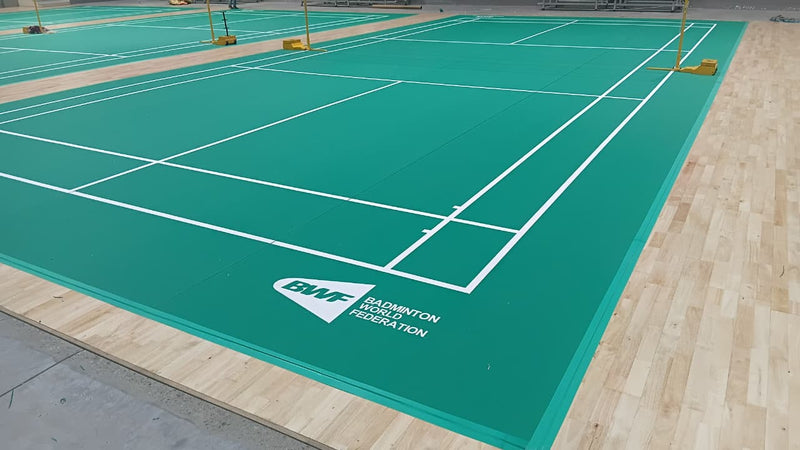
A PVC badminton court mat is a roll-laid synthetic surface available in 4.5 mm, 6 mm and 8 mm thicknesses — 4.5 mm for schools and recreation, 6 mm for clubs and academies, 8 mm BWF-grade construction for competition play. Supplied and installed per court with 40 mm line marking and edge finishing.
- Thickness options: 4.5 mm · 6 mm · 8 mm (8 mm = BWF-grade construction)
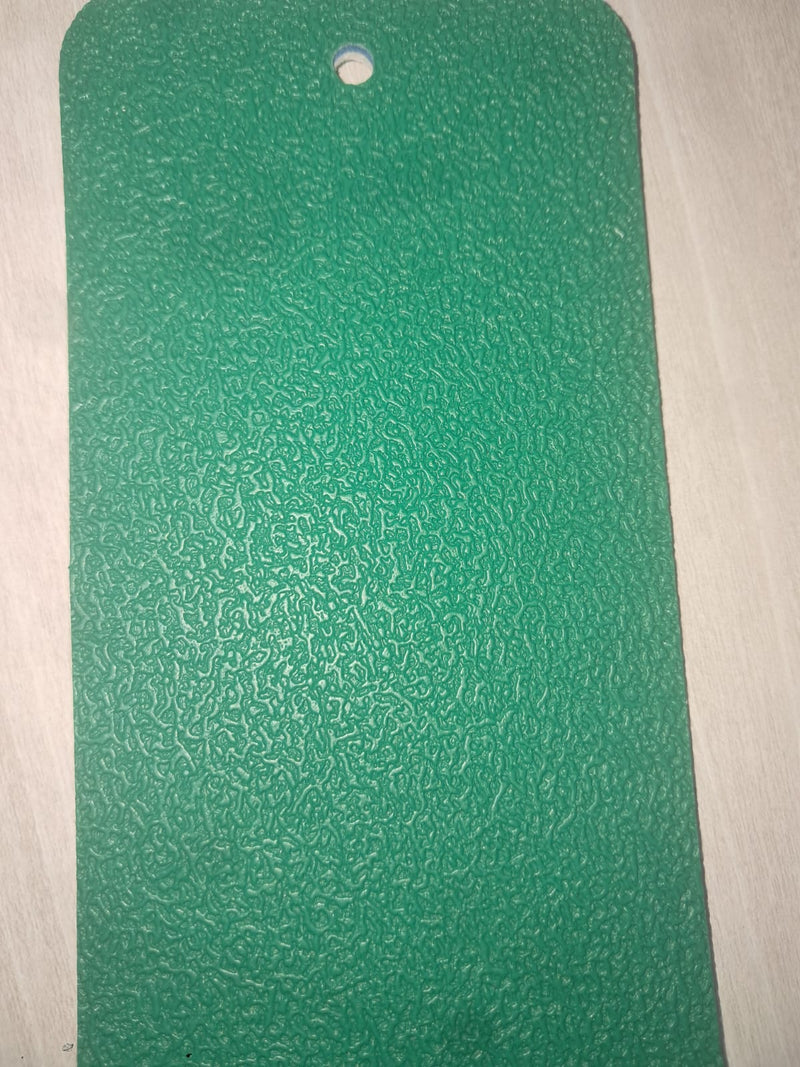
- Build: textured PVC wear layer over a shock-absorbing foam interlayer
- Sold per court: mat + fixing + seam welding + 40 mm lines + edge profiles
- Substrate: your existing RCC/PCC floor, verified flat to ≤3 mm over 3 m
- Lifespan class: 8–12 years indoors, with quarterly maintenance
- Installed range: Rs 1.1–2.5 lakh per court ex-GST across the three tiers
Updated August 2026 · Indicative ranges, ex-GST · exact rates on your written estimate

What a badminton court mat system actually contains
A mat is not one product — it is a short stack of decisions, and each shows up later as either seam life or seam trouble. Here is the full system we install, top to bottom, and why each layer is there. Still comparing mats against wooden, synthetic and acrylic badminton flooring? Start with that guide first.
| Layer | What goes in | Specification | Why it matters |
|---|---|---|---|
| Substrate | Existing RCC/PCC floor verification | Flatness ≤3 mm over a 3 m straightedge; moisture and level check | Net-height accuracy and seam life depend on a flat, dry floor |
| Substrate prep | Self-levelling compound (where required) | Cementitious SLC, localised patches | Corrects dips so the mat sits fully supported |
| Surface | PVC sports mat roll | 4.5 / 6 / 8 mm total thickness; textured wear layer; shock-absorbing foam interlayer; 8 mm tier = BWF-grade construction | The playing surface — grip, cushioning and shuttle-true bounce |
| Fixing | Full-spread PU adhesive or premium double-sided tape | Method chosen by hall usage (permanent vs re-liftable) | Keeps the mat flat and dead-stable underfoot |
| Jointing | Seam treatment | Heat-welded or cold-welded seams | Waterproof, trip-free joints between rolls |
| Marking | Court lines | 40 mm width per BWF Law 1.1, factory-marked or applied | Regulation-accurate singles and doubles play |
| Equipment | Net posts + net | Posts 1.55 m on the doubles sideline; net 6.1 m × 760 mm, 15–20 mm mesh | Complete, playable court on handover |
| Service | Installation + edge finishing | Edge profiles/ramps, debris-free handover | Safe transitions and a finished look |
What's NOT included: civil works or a new slab, hall structure, lighting, air-handling, and transport beyond the quoted zone — each is available as an itemised add-on. GST 18% extra on everything above.
Badminton court mat price — per-court sets by thickness
Marketplace listings quote mats per square metre and leave you to discover adhesive, welding, lines and freight later. We price the other way: a per-court installed set, one number per thickness, with the inclusions written down. For the full budget picture around the mat — hall, lighting, base — see the badminton court construction cost guide.
| Thickness | Tier | Installed, per court (ex-GST) | Best for |
|---|---|---|---|
| 4.5 mm | Economy | Rs 1.1–1.3 lakh | Schools, community halls, recreational play |
| 6 mm | Standard | Rs 1.5–1.8 lakh | Clubs, academies, pay-and-play venues |
| 8 mm | Premium (BWF-grade construction) | Rs 2.1–2.5 lakh | Competition play, tournament halls |
4.5 mm — Economy
The entry tier: a genuine textured PVC playing surface over a thinner foam interlayer. Right for short, mixed sessions — school PE periods, society game rooms — where budget per court is the deciding constraint.
6 mm — Standard
The tier most working venues should buy. The deeper interlayer changes how the court feels after an hour of play and shrugs off the daily multi-hour traffic that ages a 4.5 mm mat faster. Running coaching batches? Start here.
8 mm — Premium, BWF-grade construction
Competition-class cushioning — the thickness and construction grade used for serious badminton. Buy it for tournament halls, flagship academy courts, or wherever players judge a venue by how their knees feel the next morning.
Add-ons, priced separately
| Item | Indicative range (ex-GST) |
|---|---|
| Net posts + net, basic pair | Rs 6,000–8,000 |
| Net posts + net, club grade | Rs 10,000–15,000 |
| Net posts + net, tournament grade | Rs 28,000–45,000 |
| Line marking if quoted separately — single-sport scheme | Rs 5,000 |
| Line marking — multi-sport overlay schemes | Rs 5,000 per sport |
Why the price spread exists
The jump from Rs 1.1 lakh to Rs 2.5 lakh is not branding. Three things move the number: the wear layer (a thicker, denser top skin resists burn marks and abrasion for years longer), the foam interlayer (the cushioning volume is where shock absorption — and most of the raw-material cost — lives), and construction grade (the 8 mm tier is built to the material standard competition badminton demands, which means costlier compounding and tighter tolerances). Your site then adds variables: seam and welding hours, edge lengths, floor-correction patches, and distance from our supply point. That is why we publish ranges and confirm the exact figure only after the floor survey — a number quoted without seeing your slab is a guess.
Supply-only vs installed
We quote both. Supply-only gets you the mat rolls in your chosen thickness, delivered pan-India, with laying and welding guidance for your contractor. Installed adds floor verification, levelling patches, adhesive fixing, seam welding, 40 mm lines and edge profiles — and puts one party's workmanship warranty behind the finished court. Most mat failures trace back to laying, not the mat, which is worth weighing before saving on installation.
Which thickness for which buyer
| Buyer | Recommended thickness | Why |
|---|---|---|
| School | 4.5 mm | Short mixed-use sessions; budget stretches across more courts |
| Residential society | 4.5 or 6 mm | 6 mm if the hall sees daily evening play; 4.5 mm for occasional use |
| Academy | 6 mm | Multi-hour coaching loads need the deeper interlayer; 8 mm for a flagship court |
| Corporate campus | 6 mm | Reliable feel for lunchtime and league play, sensible capex |
| Pay-and-play venue | 6 mm; 8 mm flagship | Traffic durability first; one premium court lifts the venue's rate card |
| Tournament hall | 8 mm | Competition-class cushioning and BWF-grade construction |
Planning more than one court? Multi-court halls are laid as one continuous field with shared buffer lanes, which changes roll planning and seam layout — send us the hall dimensions and we will return a court-count drawing. If the hall itself is still on paper, our indoor badminton court construction service covers the building, lighting and ventilation around the mat.

How long a mat lasts — and what kills one early
An indoor PVC badminton mat sits in the 8–12 year lifespan class. The spread between those two numbers is almost entirely behaviour, not luck:
- Dragging net posts or furniture across the surface — the single most common cause of gouges and torn seams
- Wet mopping with harsh chemicals — solvents and acidic cleaners dry the wear layer and dull the texture
- Grit walked in from outside — fine abrasive that sands the surface every session
- Sun and standing water — a PVC mat is an indoor product; open-to-weather halls need a different surface
The care regime is short: dry-mop daily, damp-mop weekly with a pH-neutral cleaner, non-marking shoes only, entrance matting at the door. We recommend a quarterly maintenance visit for badminton mats — seam and edge inspection, deep clean, and a line-wear check. Over ten years, that quarterly discipline is the difference between a mat you replace and a mat you simply keep playing on; when an older court does reach the end of its surface life, court resurfacing and renovation is usually cheaper than the first build, because the hall and floor already exist.
How we install it — six stages, photo-documented
Every stage below closes with photos shared to you, so you can see the work you are paying for without standing on site.
- Floor check. We measure flatness with a 3 m straightedge — anything over 3 mm of deviation gets flagged — and check moisture and level. This gate protects everything that follows.
- Acclimatisation. Rolls are opened and left flat on site for 24–48 hours to relax and settle to hall temperature, so the mat does not move after fixing.
- Laydown. Full-spread PU adhesive for permanent courts, or premium double-sided tape where the hall needs a re-liftable surface. The choice is made with you, based on how the hall is used.
- Seam welding. Heat- or cold-welded joints between rolls — waterproof, flush and trip-free. Unwelded, glued-edge seams are where cheap installs fail first.
- Line marking. 40 mm lines per BWF Law 1.1 — factory-marked rolls aligned precisely, or lines applied on site after laying.
- Handover. Edge profiles and ramps fitted, court cleaned debris-free, care guide and warranty documents handed over.

REAL PROJECT · Hyderabad
Sarda School, Hyderabad — a ChampCourts multi-sport acrylic build with dedicated badminton markings, delivered survey-to-handover. The same team and process behind every mat court we install.

Three ways to buy a mat court — honestly compared
There are three realistic buying paths for a badminton mat court in India. Each can work; they carry different risk.
| Buying path | What you get | Where it bites |
|---|---|---|
| Marketplace supply-only mat | Competitive per-sqm material price, including genuine branded mats | Nobody verifies your floor, welds your seams or finishes your edges — and no single party is answerable if the court bubbles or lifts |
| Local unbranded contractor | One person to call, often the lowest headline quote | Material grade is rarely documented, seams are often glued rather than welded, and the warranty lasts as long as the relationship |
| Turnkey installed system | Verified floor, specified material, welded seams, finished edges, one written warranty | Costs more than the mat alone — you are paying for the part of the job that determines how long the mat lives |
As a rule, a mid-tier mat laid well outlasts a premium mat laid badly. Whichever path you choose, insist on a flatness check before laying and welded seams after it.
Specifications at a glance
| Parameter | Specification |
|---|---|
| Court core (BWF dimensions) | 44 × 20 ft (13.4 × 6.1 m) |
| Buildable footprint ladder | 49 × 26 ft (14.9 × 7.9 m) recreational · 52 × 28 ft (15.8 × 8.5 m) academy · 57 × 33 ft (17.4 × 10.1 m) national-style — never less than 2 ft (0.6 m) from any wall or obstacle |
| Clear height (if the hall is being planned) | 7 m recreational · 7.6–9 m academy · 9 m national-level |
| Mat thickness | 4.5 mm / 6 mm / 8 mm (8 mm = BWF-grade construction) |
| Roll format | Typically 1.4–1.8 m wide rolls, seams welded on site |
| Line marking | 40 mm width per BWF Law 1.1, factory-marked or applied |
| Net + posts | Posts 1.55 m (5 ft 1 in) on the doubles sideline; net 6.1 m × 760 mm |
| Substrate requirement | RCC/PCC, flat to ≤3 mm over 3 m (0.12 in over 10 ft), dry |
| Lifespan class | 8–12 years indoor, quarterly maintenance |
Full court geometry, run-offs and marking plans are in the badminton court size and dimensions guide. Prefer timber? Compare this system with a wooden sprung badminton court before deciding. Ask us for the branded spec sheet (PDF) — it carries this table plus roll layouts for each footprint.
Frequently asked questions
What is the price of a badminton court mat?
An installed PVC badminton court mat costs Rs 1.1–1.3 lakh per court in 4.5 mm (economy), Rs 1.5–1.8 lakh in 6 mm (standard) and Rs 2.1–2.5 lakh in 8 mm BWF-grade construction (premium), ex-GST. Ranges include the mat, fixing, seam welding, 40 mm lines and edge finishing; posts, nets and civil work are separate. GST 18% extra.
Which badminton mat thickness should I choose — 4.5mm, 6mm or 8mm?
Choose 4.5 mm for school PE and casual community play, 6 mm for clubs, academies and pay-and-play venues where the court runs several hours daily, and 8 mm BWF-grade construction where competition-standard cushioning matters. Thicker mats carry a deeper foam interlayer, so they absorb more impact and feel softer underfoot. Most working venues land on 6 mm.
Is an 8mm PVC mat BWF-grade?
Our 8 mm tier uses BWF-grade construction — the thickness, textured wear layer and shock-absorbing interlayer class used for competition badminton — and every court is laid to BWF dimensions with 40 mm lines. BWF certification itself belongs to specific manufacturer products, not to a thickness, so we state construction grade precisely and never claim a certificate a mat does not carry.
Can a badminton mat be laid on my existing floor?
Yes — a sound RCC/PCC, stone or tiled floor that measures flat within 3 mm over a 3 m straightedge and is dry is an ideal substrate. We verify flatness and moisture first, correct dips with self-levelling compound where needed, then fix the mat with full-spread adhesive or premium double-sided tape. Uneven or damp floors need correction before laying.
How long does a PVC badminton mat last?
An indoor PVC badminton mat sits in the 8–12 year lifespan class with basic care. Life shortens quickly if posts or furniture are dragged across it, grit is walked in, or it is mopped with harsh chemicals. A quarterly maintenance visit — seam and edge inspection plus a deep clean — keeps the surface at the upper end of that band.
Do you supply mats without installation?
Yes. We quote supply-only mats per court in all three thicknesses, delivered pan-India, with laying and welding guidance for your contractor. Installed pricing adds floor verification, adhesive fixing, seam welding, lines and edge profiles — and puts a workmanship warranty behind the whole court. Supply-only buyers carry the laying risk themselves, which is where most mat problems begin.
How is a badminton mat maintained?
Dry-mop daily, damp-mop weekly with a pH-neutral cleaner, and enforce non-marking indoor shoes. Never drag net posts or furniture across the mat, and keep grit out with entrance matting. We recommend a quarterly AMC visit covering seam and edge inspection, deep cleaning and line checks — the difference between an 8-year mat and a 12-year one.
Should I buy a branded mat from a marketplace and have it laid locally?
Branded marketplace mats are genuine products; the gap is everything after delivery — floor flatness verification, adhesive selection, seam welding, edge finishing, and one party answerable for the result. A well-laid mid-tier mat routinely outlasts a premium mat laid on an unverified floor. If you do buy supply-only, insist on a flatness check before laying and welded seams after.
Get your per-court estimate
Tell us your city, hall dimensions and how the court will be used — school, society, academy, or pay-and-play — and we will return a thickness recommendation with a written per-court estimate. Request an estimate, message us on WhatsApp (+91 92587 75187), call 92587 75187, or write to enquiry@champcourts.com.
ChampCourts Private Limited · Hyderabad HQ, installation pan-India · GSTIN 36AANCC6975A1ZG
How we build your court — 6 steps
From site survey to handover — transparent at every stage.
Site survey & assessment
Our team visits, measures, and assesses soil + drainage.
Design & material approval
You approve dimensions, colours, line plan, and add-ons.
Base preparation
M20 PCC with GSB 70mm sub-base, or surface preparation if base exists.
Surface installation
Apply surface per spec — acrylic coats, PP tiles snap-fit, vinyl welded seams.
Line marking & equipment
Court-specific lines marked to each sport's court dimensions and line-marking rules; nets, posts or hoops installed.
Handover & warranty
Final inspection, walkthrough, warranty + maintenance docs handed over.
Project gallery
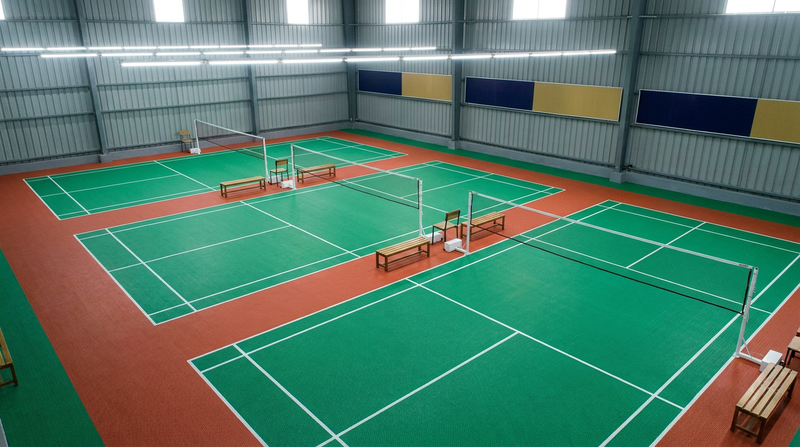
Real installations across India — schools, societies, academies, and corporate facilities.
Why ChampCourts
We're the installer, not just a material supplier.
Turnkey, not just supply
Site prep, base, surface, lines, equipment — we handle everything end-to-end.
Warranty you can rely on
Written limited warranty on surface and workmanship — terms on request. Documented and enforceable.
Pan-India service
Northeast to Bangalore — we travel where you build.
Transparent pricing
Real rates on every product page. No hidden cost, no surprises.
Frequently asked questions
Common questions about our court construction.
An installed PVC badminton court mat costs Rs 1.1-1.3 lakh per court in 4.5 mm (economy), Rs 1.5-1.8 lakh in 6 mm (standard) and Rs 2.1-2.5 lakh in 8 mm BWF-grade construction (premium), ex-GST. Ranges include the mat, fixing, seam welding, 40 mm lines and edge finishing; posts, nets and civil work are separate. GST 18% extra.
Choose 4.5 mm for school PE and casual community play, 6 mm for clubs, academies and pay-and-play venues where the court runs several hours daily, and 8 mm BWF-grade construction where competition-standard cushioning matters. Thicker mats carry a deeper foam interlayer, so they absorb more impact and feel softer underfoot. Most working venues land on 6 mm.
Our 8 mm tier uses BWF-grade construction — the thickness, textured wear layer and shock-absorbing interlayer class used for competition badminton — and every court is laid to BWF dimensions with 40 mm lines. BWF certification itself belongs to specific manufacturer products, not to a thickness, so we state construction grade precisely and never claim a certificate a mat does not carry.
Yes — a sound RCC/PCC, stone or tiled floor that measures flat within 3 mm over a 3 m straightedge and is dry is an ideal substrate. We verify flatness and moisture first, correct dips with self-levelling compound where needed, then fix the mat with full-spread adhesive or premium double-sided tape. Uneven or damp floors need correction before laying.
An indoor PVC badminton mat sits in the 8-12 year lifespan class with basic care. Life shortens quickly if posts or furniture are dragged across it, grit is walked in, or it is mopped with harsh chemicals. A quarterly maintenance visit — seam and edge inspection plus a deep clean — keeps the surface at the upper end of that band.
Yes. We quote supply-only mats per court in all three thicknesses, delivered pan-India, with laying and welding guidance for your contractor. Installed pricing adds floor verification, adhesive fixing, seam welding, lines and edge profiles — and puts a workmanship warranty behind the whole court. Supply-only buyers carry the laying risk themselves, which is where most mat problems begin.
Dry-mop daily, damp-mop weekly with a pH-neutral cleaner, and enforce non-marking indoor shoes. Never drag net posts or furniture across the mat, and keep grit out with entrance matting. We recommend a quarterly AMC visit covering seam and edge inspection, deep cleaning and line checks — the difference between an 8-year mat and a 12-year one.
Branded marketplace mats are genuine products; the gap is everything after delivery — floor flatness verification, adhesive selection, seam welding, edge finishing, and one party answerable for the result. A well-laid mid-tier mat routinely outlasts a premium mat laid on an unverified floor. If you do buy supply-only, insist on a flatness check before laying and welded seams after.
Ready to build your court?
Free written quotation. No commitment.
Prefer to call or WhatsApp?