
ChampCourts Synthetic Acrylic Sports Flooring


Seamless acrylic courts for basketball, tennis, badminton and pickleball.
From ₹25 / sq ft (ex-GST)
- 2–12 layers
- Pan-India delivery
- Free quote in 2 hours
Choose your layers & base
Pick a layer count and your existing base. We'll show live pricing and your minimum order area.
Minimum order: 7200 sq ft
Price on a prepared concrete base. Asphalt +10/sq ft (ex-GST). Base correction or repair quoted after inspection.
Need a new concrete base? We build it —quoted separately.
Is this surface right for you?
Best for
- Schools
- Colleges
- Housing societies
- Academies
- Clubs
- Resorts
- Corporates
- Government
Note
This surface is acceptable but not recommended for:
- Indoor tournament badminton
- Cracked or damp base, until corrected
- A soft feel on builds under 6 layers
Talk to us — we'll honestly advise the right fit for your goals.
Our recommendations follow court-dimension standards and what we see on real installations. No surface is one-size-fits-all — we'd rather lose a sale than build the wrong court.
Choose 2 to 12 layers
Every layer serves a purpose. Tap to explore what goes into your acrylic system.
Your prepared concrete or asphalt base is the structural foundation this system is applied over. Everything above depends on this layer being sound — we assess it before quoting.
Acrylic primer that bonds the system to the base. Applied only after the base has cured and its moisture is below 5% — trapped moisture is what makes coatings blister and peel.
Fills minor surface imperfections and levels the court. Mixed with silica sand for texture. Used from 3 layers upward.
A second resurfacer pass for a flatter, more uniform playing surface. Used from 5 layers upward.
First rubber-granule cushion layer. Absorbs impact and reduces joint stress during play. Cushion layers are added from 6 layers upward — 6 layers has 1, 8 layers has 3, 12 layers has 7.
A second cushion coat adds more give underfoot, helping reduce strain on knees and ankles during longer sessions. Used from 7 layers upward.
Additional cushion layers build progressively for higher layer counts, improving energy return for ball bounce consistency across the surface.
Pigmented acrylic in your chosen colour with silica sand for grip, UV-stabilised for colour stability. One coat on 2–3 layer builds, two coats from 4 layers. Available in 7 colours.
Line marking built to FIBA, BWF and ITF court dimensions, using the line widths each sport specifies. Multi-sport marking and club or school logos available on request.
Tap any layer to learn what it does.
Full layer pricing table
Compare every layer count side by side before you choose.
| Layers | Concrete ₹/sq ft | Asphalt ₹/sq ft | Minimum order (sq ft) | Warranty | Cushion layers |
|---|---|---|---|---|---|
| 2 | 25 | 35 | 7,200 | — | — |
| 3 | 33 | 43 | 4,800 | — | — |
| 4 | 42 | 52 | 3,600 | — | — |
| 5 | 50 | 60 | 2,880 | — | — |
| 6 | 60 | 70 | 2,400 | — | 1 |
| 7 | 67 | 77 | 2,058 | — | 2 |
| 8 | 75 | 85 | 1,800 | 2 years | 3 |
| 9 | 83 | 93 | 1,800 | 2 years | 4 |
| 10 | 91 | 101 | 1,800 | 2 years | 5 |
| 11 | 99 | 109 | 1,800 | 2 years | 6 |
| 12 | 107 | 117 | 1,800 | 2 years | 7 |
Prices per sq ft, ex-GST, supply + application, pan-India delivery.
Acrylic System Specifications
| Specification | Detail | More detail | Notes |
|---|---|---|---|
| Layer options | 2–12 layers (custom builds on request) | Built to FIBA / BWF / ITF dimensions | Full layer application |
| System thickness | Approx. 1.4–2 mm at 8 layers | Approx. 3–3.5 mm at 12 layers | Thin coating bonded to the base |
| Ready for play | After 48 hours of dry weather | ||
| Ball bounce | True and consistent | Seamless — no joints or seams | Sand-textured finish for grip |
| Maintenance | Sweep and rinse with plain water | Low effort | No waxing or sealing needed |
| Base Required | Prepared concrete or asphalt | You supply, or we build it separately | Proper slope for drainage |
- Detail
- 2–12 layers (custom builds on request)
- More detail
- Built to FIBA / BWF / ITF dimensions
- Notes
- Full layer application
- Detail
- Approx. 1.4–2 mm at 8 layers
- More detail
- Approx. 3–3.5 mm at 12 layers
- Notes
- Thin coating bonded to the base
- Detail
- After 48 hours of dry weather
- Detail
- True and consistent
- More detail
- Seamless — no joints or seams
- Notes
- Sand-textured finish for grip
- Detail
- Sweep and rinse with plain water
- More detail
- Low effort
- Notes
- No waxing or sealing needed
- Detail
- Prepared concrete or asphalt
- More detail
- You supply, or we build it separately
- Notes
- Proper slope for drainage
Popular acrylic colours
A few popular shades — many more colours and multi-colour combinations are available on request.
- Terracotta Red
- Grass Green
- Dark Green
- Grey
- Light Blue
- Royal Blue
- Dark Blue
Made-to-order colours have a lead time of 14 days.
Real installation clips
Watch our crews build acrylic courts across India.
Our projects
Schools, homes, academies and public sports complexes — acrylic courts ChampCourts has built across India.
 REAL PROJECT · Sivakasi
Twin Pickleball Arena
 REAL PROJECT · Dwarka, New Delhi
St Mary's School — Basketball Court Resurfacing
Read the story REAL PROJECT · Hyderabad
Sarda School — Floodlit Multi-Sport Court
 REAL PROJECT · Khopoli (Raigad)
Rooftop Pickleball Court
 REAL PROJECT · Dehradun
Lawn Pickleball Court
 REAL PROJECT · Amravati
Residential Pickleball Court
 REAL PROJECT · Pune
Garden Badminton Court
 REAL PROJECT · Bilaspur
Caged Multi-Sport Court
 REAL PROJECT · Barsi
Multi-Court Facility
 REAL PROJECT · Chalisgaon
Riverfront Public Sports Complex
Also available for
The same acrylic system, priced for your sport.
The complete guide to synthetic acrylic sports flooring
Synthetic acrylic sports flooring is a multi-coat acrylic surface applied on site over a prepared concrete or asphalt base. Its main advantage is that it bonds as one seamless, UV-stable layer, so the court plays true, holds up to Indian sun and monsoon, and can be recoated in place instead of replaced.
ChampCourts builds it in 2 to 12 layers of primer, resurfacer, cushion and colour, to FIBA, BWF and ITF court dimensions for basketball, tennis, badminton, pickleball and volleyball courts.
It works indoor and outdoor, across new construction and resurfacing jobs, pan-India, from ₹25 per sq ft ex-GST.
From a floodlit twin pickleball arena in Sivakasi to a resurfaced school basketball court in Dwarka, New Delhi, ChampCourts crews have laid this surface for schools, homes, academies and public sports complexes across India — and every court is checked coat by coat before handover.
Why schools, clubs and homeowners choose ChampCourts
Buyers pick ChampCourts synthetic acrylic flooring because the proof, the pricing and the people behind every court are out in the open.
- Proven across India. ChampCourts has built 200+ sports courts across 12+ states — the project stories further down this page show a few of them.
- Trained, supervised crews. Your court is applied by trained applicator crews working under ChampCourts supervision, with a quality check at every coat.
- Clear per-sq-ft pricing. Pick your layer count and base on this page and see the rate straight away, from ₹25 per sq ft ex-GST.
- A free quotation within 2 hours. Share your sport, court size and base, and the quotation comes back the same day.
- Honest advice. If acrylic isn't right for your site, we'll tell you — the limitations are listed openly further down this page.
Where acrylic sports flooring is used, indoors and outdoors
Acrylic flooring converts a plain concrete or asphalt base into a line-marked, ball-true playing surface for basketball courts, tennis courts, badminton and pickleball courts, both indoors and outdoors.
Whether you're planning new tennis court construction or resurfacing an existing court, it's a common choice for schools, colleges, housing societies, sports academies, clubs, resorts, corporates and government sports complexes across India. It's one of the most common outdoor sports flooring choices in India, and a familiar sight at schools, clubs and resorts nationwide.
Basketball court flooring
Full FIBA-dimension courts for schools, colleges and academies, plus half-courts for housing societies and corporate campuses. See the acrylic basketball court page.
Tennis courts
Built to ITF court dimensions for clubs, resorts, gated communities and academies. See acrylic tennis court flooring.
Badminton court flooring
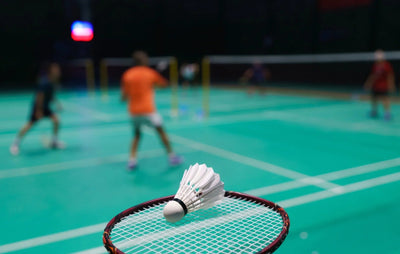
Built to BWF court dimensions for outdoor and recreational play at academies, schools and sports clubs. See the badminton courts collection, and the limitations section below for indoor tournament badminton.
Pickleball courts
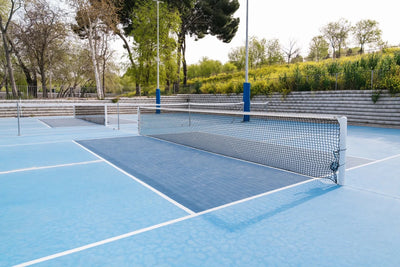
A fast-growing category for resorts, clubs, residential complexes and rooftops. See the acrylic pickleball court.
Volleyball courts and multi-sport layouts
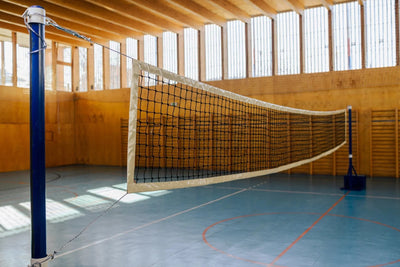
Shared-use volleyball courts and multipurpose layouts for schools, corporates and government sports complexes, with line marking for more than one sport on the same surface.
Advantages of synthetic acrylic sports flooring
Acrylic gives a true, consistent ball bounce and a seamless, hard-bonded finish — no tile joints or seams to catch a foot or a bounce. Colours are UV-stable, multiple sports can share one surface through line marking in different colours, and the coating can be repaired or recoated in place rather than replaced.
Acrylic coatings resist fading and hold their colour well through Indian summers and monsoons — a high-performance surface built for Indian heat, UV and monsoon cycles.
Acrylic is also a common hard-court surface at professional outdoor tournaments worldwide.
Playing pace can be tuned by adjusting the texture of the resurfacer and colour coats — a slower or faster feel, without changing the base material. Among synthetic sports surfaces, it is one of the most popular choices for outdoor hard courts in India.
Limitations — when acrylic flooring isn't the right choice
Acrylic is the wrong choice in two situations: indoor tournament badminton, and any site where the base is failing and will not be repaired first. Everywhere else the trade-offs below are manageable — but worth knowing before you order.
- Hard feel below 6 layers. Builds under 6 layers have no cushion coats, so the surface feels harder underfoot than a cushioned build.
- Needs a sound, dry base. Acrylic bonds to the base it's applied on — a base that's cracked, uneven or still curing will show through the coating and can shorten its life.
- Base cracks can telegraph through the coating. Acrylic seals and treats existing cracks; it doesn't stop a structural crack in the base from reappearing over time.
- Recoating is needed over time. Like any painted hard-court surface, colour and texture wear down with use and weather, and the court will need recoating eventually — see Maintenance below.
- Not the standard for indoor tournament badminton. The Badminton World Federation's approved indoor flooring list covers sprung wooden floors, PVC and vinyl court mats and polyurethane (PU) sports floors — acrylic isn't on it. Acrylic badminton courts suit outdoor and recreational play, not indoor competition-grade requirements.
- Can be slippery when wet. Like any hard court surface, a wet acrylic court has reduced grip — avoid play during or immediately after rain until the surface has dried.
Base, layer count and use case all need to be right for your site — talk to us about your specific requirement before you order.
The layer system: 2 to 12 layers
The layer count is the one choice that changes both what you pay and how the court feels underfoot. More layers add thickness, colour depth and — from 6 layers up — cushioning, not a different material. An 8-layer system is about 1.4–2 mm thick in total, and a 12-layer system about 3–3.5 mm.
Every build starts with a bonding coat, adds resurfacer and colour coats as the layer count goes up, and adds cushion coats from 6 layers upward. 2 to 12 are our standard builds; custom builds to any requirement are available on request.
Layer table: minimum order area and coat count
Read the table left to right: the layer count, the minimum order area it can be supplied for, and how many primer, resurfacer, cushion and colour coats that build contains.
| Layers | Minimum order (sq ft) | Primer | Resurfacer | Cushion | Colour |
|---|---|---|---|---|---|
| 2 | 7,200 | 1 | 0 | 0 | 1 |
| 3 | 4,800 | 1 | 1 | 0 | 1 |
| 4 | 3,600 | 1 | 1 | 0 | 2 |
| 5 | 2,880 | 1 | 2 | 0 | 2 |
| 6 | 2,400 | 1 | 2 | 1 | 2 |
| 7 | 2,058 | 1 | 2 | 2 | 2 |
| 8 | 1,800 | 1 | 2 | 3 | 2 |
| 9 | 1,800 | 1 | 2 | 4 | 2 |
| 10 | 1,800 | 1 | 2 | 5 | 2 |
| 11 | 1,800 | 1 | 2 | 6 | 2 |
| 12 | 1,800 | 1 | 2 | 7 | 2 |
Only acrylic builds of 8 layers and above carry a 2-year warranty. Builds below 8 layers are supplied without warranty.
Which build suits your court?
The right layer count depends on how the court will be used and how many hours of play it will see each day.
- Home, lawn or rooftop court for relaxed play: a lighter 4- or 5-layer build keeps the cost down — the lawn pickleball court we built in Dehradun is a 5-layer build.
- School, society or corporate court in daily use: 5 to 7 layers, with cushion coats from 6 layers for more comfort underfoot.
- Academies, clubs and long playing hours: 8 layers and above, with three or more cushion coats and a 2-year warranty on the acrylic build.
Cushion layers explained
Cushion coats are rubber-granule acrylic layers added beneath the colour coat, starting at 6 layers and adding one more coat with each layer after that — up to 3 cushion coats at 8 layers and 7 cushion coats at 12 layers. They absorb impact and reduce joint and muscle fatigue during play.
Builds below 6 layers have no cushion coats and feel harder underfoot, which is why choosing between (for example) a 5-layer and an 8-layer system usually comes down to budget versus underfoot feel and expected hours of play.
Your base: concrete, RCC and asphalt — and why moisture matters
The base decides how long an acrylic court lasts. The system bonds directly to it, so the finished surface can only be as level, as sound and as dry as whatever sits underneath. ChampCourts works with these base types:
- Prepared concrete base — our standard price basis; a sound, level, fully cured slab gives the system the best bond and the truest playing surface.
- Asphalt — also available, at +₹10 per sq ft over the standard concrete-base rate.
- New PCC, new RCC or new asphalt base built by us — quoted separately from the flooring system.
- Base correction or repair — cracked, uneven or poorly cured base is corrected before any coating goes down; quoted after inspection.
New concrete needs to cure for 28 days, and moisture must test under 5% before coating begins.
Concrete slabs release moisture continuously as they cure. If that moisture is trapped under an acrylic coating, it builds pressure under the film and causes blistering or peeling — which is why the base is moisture-tested before coating begins.
Base quality — cure time, moisture and levelness — is the single biggest factor in the coating's long-term durability.
Quality checks and certifications
Three things back the quality claim: an ITF pace classification on the material, courts built to each sport's governing-body dimensions, and a fixed set of site checks run on every job from base inspection to final handover.
- ChampCourts' acrylic material is ITF-classified — the International Tennis Federation's Court Pace Classification rates a surface product's playing pace category; it doesn't itself imply ITF approval or endorsement of the installed court.
- Courts are built to FIBA, BWF and ITF court dimensions, as applicable to the sport.
- ChampCourts is a registered MSME (Udyam), a GeM seller, and a DPIIT-recognised startup.
- Every job goes through the same site checks: base inspection for cracks and level, a moisture check before coating, crack treatment before any coat goes down, application only in suitable weather (no rain expected, humid or hot conditions avoided), inspection of each coat as it's applied, a flood test for standing water once the system is complete, and a final walkthrough and handover.
Our installation process, step by step
Installation runs in eight stages, and the first three are about the base rather than the coating — which is where a court's working life is actually decided. Here is the sequence from enquiry to handover.
- Free quotation, then base inspection — share your court size, sport and base details for a free quotation within 2 hours; before work starts, the base is inspected for level, cracks and cure condition, or a new base is planned.
- Base build or correction — build a new PCC, RCC or asphalt base, or repair and correct the existing one, before any coating goes down.
- Moisture check — confirm the base tests dry, under 5% moisture, before coating begins.
- Primer coat — bonds the acrylic system to the base.
- Resurfacer coats — build a smooth, consistent layer across the court.
- Cushion coats (6 layers and above) — add shock absorption beneath the colour coat.
- Colour coats and line marking — the UV-stable finish goes down last, followed by court lines for basketball, tennis, badminton, pickleball or multi-sport markings.
- Ready for play — the court is ready for play 48 hours after the final coat, given dry weather.
- Handover — a final walkthrough with your care guide.
Who applies your court
Every ChampCourts acrylic floor is applied by trained applicator crews working under ChampCourts supervision and quality checks — from the first coat to the final walkthrough.
Our crews have coated courts in very different settings across India, so they know what a court needs before the first coat goes down: when a base is still too damp to coat, when the weather is wrong for application, and how to keep lines crisp where several sports share one surface. The same care goes into a 5-layer lawn court as into an 8-layer academy court.
Acrylic vs PP tiles vs PU vs wooden vs vinyl flooring
The short version: acrylic wins outdoors, PP interlocking tiles win when the base is poor or the court has to move, and sprung wooden or vinyl systems win indoors for tournament badminton.
Below, the acrylic surface is compared with modular PP interlocking tiles, poured PU, sprung wooden floors, vinyl/PVC mats and other overlays such as rubber flooring, so you can judge it against each alternative before you decide.
Comparison table: acrylic vs PP tiles, PU, wooden and vinyl flooring
For an outdoor court on a sound base, acrylic is the strongest all-round choice of the five — here is how each system differs.
| Factor | Acrylic | PP interlocking tiles | PU (polyurethane) | Wooden (sprung) | Vinyl / PVC mat |
|---|---|---|---|---|---|
| Installation | Multi-coat system applied on-site and bonded to the base | Modular tiles that snap together, no bonding coats | Poured or sprayed on-site onto a prepared base | Sprung floor system built up indoors | Rolled or loose-laid mat, glued or taped |
| Base needed | Cured, prepared concrete or asphalt | Concrete or a compacted sub-base | Cured, prepared concrete | A supporting sub-floor structure | A flat, clean indoor floor |
| Underfoot feel | Hard-bonded, true ball bounce | Slight give from the interlocking structure | Cushioned, more give than acrylic | Sprung, most shock-absorbing | Resilient, moderate give |
| Repairs | Patch or recoat the affected area | Lift and swap individual tiles | Patch or recoat the affected area | Specialist repair or board replacement | Patch or replace the affected section |
| Typical setting | Outdoor courts for tennis, basketball and multi-sport | Outdoor and indoor multi-sport, portable setups | Indoor sports halls, running tracks | Indoor tournament badminton, basketball halls | Indoor badminton and basketball halls |
| Maintenance | Routine cleaning, periodic recoating | Routine cleaning, tile replacement as needed | Routine cleaning, periodic resurfacing | Specialist floor care | Routine cleaning |
Compare acrylic against a modular, base-tolerant surface on the PP tile courts page if that suits your site better.
Colours, line marking and logos
Courts come in a range of standard colours, with custom colour combinations available for multi-sport line marking — different colours for different sport lines on the same shared surface.
Club or school logos can be painted on request.
Maintenance and repainting
An acrylic court needs water and nothing else — no chemicals, no waxing, no annual service contract — plus a recoat when the surface itself tells you it is due.
Clean an acrylic court with water only — sweep and rinse with plain water; contact ChampCourts if you have a stain that plain water won't shift.
Avoid dragging sharp furniture, spiked footwear or heavy equipment across the surface, and clear standing water promptly after rain.
Recoat when you notice fading, a smoother, less grippy surface texture, or fine surface cracking, rather than on a fixed calendar — climate and how much the court is used both affect how long a coat lasts. Routine care and periodic recoating keep the surface long-lasting and performing well, without redoing the whole system from the base up.
Installation and maintenance go hand in hand: every ChampCourts court is handed over with a care guide, so the right upkeep starts from day one.
What affects the cost of acrylic flooring
Price starts at ₹25 per sq ft, ex-GST, and is driven mainly by one variable: the layer count.
That rate covers supply and application on a prepared concrete base, and heavier layer systems cost more per sq ft than lighter ones. Beyond the layer count, four things change your quote:
- Base condition and type — an existing base in good condition costs less to prepare than one needing correction or repair, or a new PCC, RCC or asphalt base built from scratch; asphalt carries a +₹10 per sq ft surcharge over concrete.
- Area versus the minimum order — each layer count has its own minimum order area (see the layer table above); areas below the minimum are priced at the minimum.
- Colours and line marking — custom colour combinations and multi-sport line layouts.
- Site access and location — pan-India delivery, but site access and distance can affect logistics.
Share your court's sport, area, layers and current base condition to get an exact quote.
Our acrylic court projects across India
ChampCourts has built acrylic courts across India, from school campuses and residential rooftops to public sports areas. A few of them:
- St Mary's School, Dwarka, New Delhi — an existing school basketball court, mesh-reinforced and rebuilt into a fresh 8-layer acrylic surface across 6,420 sq ft.
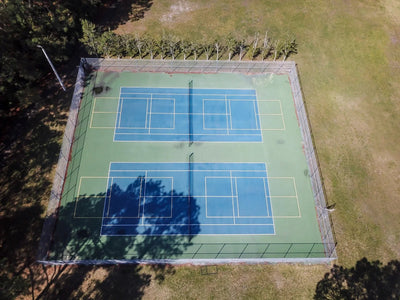
- Twin pickleball arena, Sivakasi, Tamil Nadu — two fully enclosed, floodlit pickleball courts on 3,600 sq ft, delivered from the engineered base to the final line marking.
- Sarda School, Hyderabad — a floodlit, fully enclosed school court with basketball and badminton on one surface, day and night.
- Rooftop pickleball court, Khopoli, Maharashtra — a hillside rooftop turned into a netted 8-layer pickleball court.
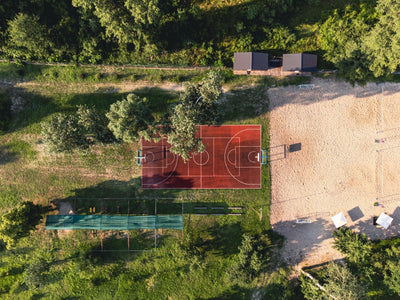
- Riverfront public sports complex, Chalisgaon, Maharashtra — acrylic badminton and pickleball courts beside a box cricket arena on a public riverfront.
- Caged courtyard court, Bilaspur, Chhattisgarh — a fully caged court for a residential development, so the game stays in and the neighbours' windows stay whole.
Browse all the project cards on this page by sport, city and layer count, and watch the installation clips to see our crews at work.
Pan-India delivery and how to get a quote
ChampCourts supplies and applies this acrylic flooring system pan-India — 200+ courts across 12+ states — as part of its broader sports infra work for schools, colleges, resorts, clubs and residential developments.
Quotes are ex-GST, for supply plus application on a prepared base. Share your court's sport, area and current base condition (existing or new, concrete or asphalt) to get a quote, or start from the acrylic courts overview to compare against PP tiles and other surface options first.
Quotations are free and sent within 2 hours of receiving your court details. Payment plans are flexible and agreed with your ChampCourts sales representative.
How we build your court — 6 steps
From your free quotation to handover — clear at every stage.
Free quotation within 2 hours
Share your court size, sport and base details — we send a free quotation within 2 hours. The base is inspected before work starts.
Design & material approval
You approve dimensions, colours, line plan, and add-ons.
Base preparation
Base inspection, crack treatment and moisture check (below 5%). New concrete cures 28 days. New PCC, RCC or asphalt bases are quoted separately.
Acrylic coats, applied by trained crews
Trained ChampCourts crews apply the primer, resurfacer, cushion and colour coats for your layer count — each coat inspected before the next goes down, and only in suitable weather.
Line marking & equipment
Lines marked to FIBA, BWF or ITF court dimensions, with multi-sport lines and club or school logos on request. Nets, posts and hoops can be added to your quote.
Handover & warranty
Final inspection, walkthrough and written care guide; 2-year warranty on 8 layers and above.
Frequently asked questions
Straight answers about acrylic flooring — layers, base, pricing and upkeep.
Build: 2 to 12 layers (primer, resurfacer, cushion, colour). Thickness: about 1.4–2 mm at 8 layers and 3–3.5 mm at 12 layers. Cushion coats: from 6 layers — 3 at 8 layers, 7 at 12. Base: prepared concrete as standard, asphalt at +₹10 per sq ft. Base condition: 28-day cure, under 5% moisture.
Price: from ₹25 per sq ft ex-GST, supply and application. Minimum order: 7,200 sq ft at 2 layers down to 1,800 sq ft at 8 layers and above. Warranty: 2 years on 8-layer and higher builds only. Standards: ITF-classified material; courts built to FIBA, BWF and ITF dimensions. Ready for play: 48 hours after the final coat.
Layers of acrylic run from 2 to 12, and the count changes thickness, colour depth and cushioning — not the material. Below 6 layers there are no cushion coats, so the court plays harder; from 6 up, each extra layer adds another cushion coat.
School and society courts usually land at 5–7 layers; academies and clubs with long daily playing hours are better at 8 and above, which is also where the 2-year warranty begins.
Base inspection, then base build or correction, then a moisture check under 5%, then primer, resurfacer coats, cushion coats on 6-layer and heavier builds, colour coats and line marking, and finally a flood test and handover.
Every coat is inspected as it goes down, and coats are applied only in suitable weather.
A well-built acrylic court on a sound base is made for daily play, and when the surface does wear, only the top coats are renewed rather than the whole system.
Lifespan is decided mostly by base quality, layer count, playing hours and climate rather than by the acrylic itself — which is why base preparation and moisture testing get so much attention.
From ₹25 per sq ft, ex-GST, for supply and application on a prepared concrete base.
Your actual rate depends on the layer count, the base (asphalt adds ₹10 per sq ft; a new base or repairs are quoted separately), your area against the minimum order for that layer count, and the colour and line-marking layout.
Ready to build your court?
Tell us your sport, court size and base — your free quotation arrives within 2 hours. No commitment.
Prefer to call or WhatsApp?