

Get a free estimate for yourCOURT
Multi-Sport Court — PP Interlocking Tiles
Turnkey InstallationTurnkey court construction, transparent pricing, and a free site assessment. Pan-India service.
Configure your court
Prices are indicative per sqft, ex-GST. Use the cost calculator below for a full project estimate including base, kerbs, line marking, and add-ons.
Calculate Your Court Cost
Pre-configured for this surface. Enter dimensions for an instant estimate — no signup required.
Which sport will this court be used for?
How many courts and what configuration?
What surface type do you want?
What is the base / sub-structure situation?
Any add-ons? (Optional — all can be added later)
Indicative range only. Actual pricing depends on site conditions, geography, and final material availability. Use the WhatsApp button to send your configuration directly to our team for a detailed estimate within 5 minutes.
Is this surface right for you?
Best for
- Schools
- Society
- Modular
- Fast install
Our recommendations are based on governing-body standards and 10+ years of installation experience. No surface is one-size-fits-all — we'd rather lose a sale than build the wrong court.
Overview
A multi-sport PP interlocking tile court is the highest-utilisation product in the ChampCourts range. With a single surface, owners can rotate basketball, badminton, volleyball, and tennis matches through a single venue — squeezing 3 to 4 times more weekly play hours out of the same footprint. ChampCourts installs multi-sport PP tile courts at ₹105–115 per sqft, with up to four sports' lines pre-printed in contrasting colours, a 5-year warranty, and pan-India service. The product is engineered for schools, residential societies, corporate campuses, and community recreation centres where space and budget are both limited. (Figures are indicative and vary by area, site condition and specification — request a free itemised estimate.)
Specifications
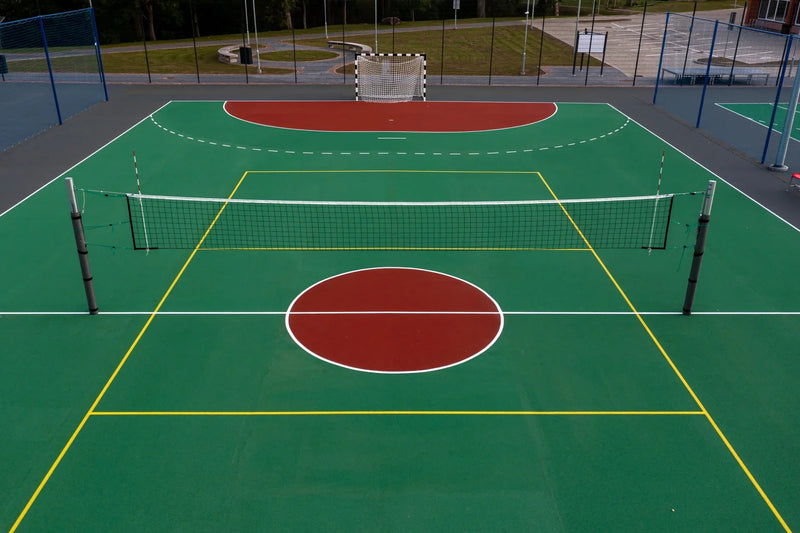
The court is sized to the largest of the chosen sports (typically basketball) and the other sports' lines are overlaid in different colours. The most common combination is basketball + badminton + volleyball + tennis on a 28 x 15 m footprint.
| Sport | Court size | Standard |
|---|---|---|
| Basketball (full court) | 28 m x 15 m | FIBA |
| Badminton (doubles, 1 court) | 13.4 m x 6.1 m | BWF |
| Badminton (doubles, 2 courts) | 2 x (13.4 m x 6.1 m) | BWF (parallel) |
| Volleyball | 18 m x 9 m | FIVB |
| Tennis (singles) | 23.77 m x 8.23 m | ITF |
| Pickleball | 13.41 m x 6.10 m | USA Pickleball |
Cost Breakdown
| Component | Rate | Notes |
|---|---|---|
| PP tiles (supply + install) | ₹105–115 per sqft | Up to 4 sports' lines included |
| PCC sub-base | Rs 90 per sqft | If no slab |
| Basketball goals (pair) | Rs 90,000 to Rs 1,80,000 | Wall-mounted preferred |
| Badminton posts + net (per court) | Rs 6,000 to Rs 12,000 | Portable bases |
| Volleyball posts + net | Rs 25,000 to Rs 45,000 | Telescoping |
| Tennis posts + net | Rs 18,000 to Rs 35,000 | Removable |
| Fencing (4 m chain-link) | Rs 250 to Rs 400 per running ft | Recommended |
| LED floodlights (4 to 6 nos) | Rs 80,000 to Rs 1,80,000 | For evening play |
A 28 x 15 m footprint with PCC, tiles, basketball goals, portable badminton/volleyball/tennis equipment, fencing, and lighting lands at Rs 7 lakh to Rs 11 lakh — versus Rs 12 lakh to Rs 18 lakh for an equivalent acrylic build.
Why Multi-Sport Tiles
The economic argument is utilisation. A single-sport court runs at 25 to 40 per cent of available weekday hours. A 4-sport configuration pushes that to 75 to 90 per cent, because badminton fills mornings, basketball fills evenings, volleyball runs weekends, and tennis takes the off-peak slots. The line-colour system (white for basketball, yellow for badminton, blue for volleyball, green for tennis) eliminates confusion during play. For schools, this means one court serves the entire PT curriculum.
Comparison vs Alternatives
| Surface | Rate | Multi-sport ready | Lifespan |
|---|---|---|---|
| PP tiles | ₹105–115 per sqft | Yes, up to 4 sports | 3 to 5 yrs |
| Acrylic | Rs 155 per sqft | Yes, 2 to 3 sports | 7 to 10 yrs |
| Vinyl (indoor) | Rs 80 to Rs 150 per sqft | Yes, up to 5 sports | 10 to 15 yrs |
| Bare concrete + paint | Rs 35 to Rs 50 per sqft | Limited, repaint yearly | 1 to 2 yrs |
Construction Process
- Site survey and footprint planning around chosen sport combination.
- PCC sub-base laying with 1-in-100 cross-slope.
- 21-day concrete cure.
- Sport-line colour scheme finalised on paper.
- Tiles laid in colour pattern to form all chosen sports' lines.
- Goal post foundations and basketball goal installation.
- Portable post sleeves for badminton, volleyball, tennis.
- Fencing and LED installation.
- Handover with sport-rotation operating guide.
- Warranty registration.
Use Cases
- K-12 schools (one court for entire PT programme)
- Residential apartment complexes (200+ unit projects)
- Corporate campuses
- Community sports zones in housing projects
- Hotels and resorts (guest recreation)
FAQ
Q: Do the multi-sport lines confuse players?
The colour-coding system (white/yellow/blue/green) is standard internationally. Players adapt within minutes.
Q: Can equipment be left on the court between games?
Portable badminton and volleyball posts are stored off-court. Basketball goals stay in place. Tennis posts go up only during tennis sessions.
Q: What is the most common 2-sport pairing?
Basketball + badminton (2 to 3 parallel badminton courts overlap the basketball footprint). Volleyball + badminton is the second most common.
Q: Can lines be added later?
Yes. Additional sport lines can be applied as painted overlays at Rs 8 to Rs 12 per sqft of court area.
Q: What ceiling height is needed for badminton on this court?
BWF recommends 9 m for international play and 7.5 m for general matches. Most school halls work at 6 m for recreational use.
Line Marking Colour System
The colour-coded line system is what makes a 4-sport court usable rather than confusing. Following BWF and FIBA secondary-sport line guidance:
| Sport | Line colour | Width |
|---|---|---|
| Basketball (primary) | White | 50 mm |
| Badminton | Yellow | 40 mm |
| Volleyball | Blue | 50 mm |
| Tennis | Green | 50 mm |
| Pickleball (if added) | Red | 40 mm |
The white-on-blue or white-on-green primary basketball lines are most visible; secondary sports use saturated colours that are visible during their own play but recede during basketball games. This colour discipline is standard at international multi-sport halls and is what allows players to focus on their sport without visual clutter.
Utilisation Economics
The financial advantage of multi-sport courts comes from spreading capex across more activity-hours. A single-sport basketball court at a school typically books 25 to 30 PT hours a week. The same footprint with multi-sport lines can deliver:
- Basketball: 15 to 20 hours per week (after-school + PT periods)
- Badminton (2 parallel courts within the footprint): 25 to 35 hours per week
- Volleyball: 8 to 12 hours per week
- Tennis (singles only on partial footprint): 5 to 10 hours per week
Total: 53 to 77 hours of activity per week versus 25 to 30 for single-sport — a 2x to 3x utilisation jump. For paid facilities, this translates directly into 2x to 3x revenue per court.
Equipment Storage and Switch-over
Rapid sport switch-over is what makes multi-sport courts practical. We design every installation with sport-specific equipment storage:
- Floor sleeves at portable post positions. Capped sleeves at standard volleyball, badminton, and tennis post locations allow tool-free post insertion and removal.
- Adjacent equipment cabinet. A weather-protected 8 x 4 x 2 ft cabinet stores nets, posts, ball boxes, and basketball stands.
- Switch-over time. Two-person team can change court configuration in 6 to 10 minutes between sports.
Lighting Design for Multi-Sport
Lighting requirements vary by sport. Badminton needs the highest lux (500 to 750), tennis next (500), then volleyball and basketball (300 to 400). Our standard recommendation for a 28 x 15 m multi-sport court is 6 nos 200 W LEDs on 6 m poles, delivering 550 to 650 lux across the full footprint with 0.7 uniformity ratio — sufficient for all four sports at recreational and club-level play. For premium installations, 8 nos 300 W LEDs hit 800 lux for tournament-grade lighting.
Real Project Reference
A 350-flat residential project in Hyderabad's Gachibowli installed a multi-sport PP-tile court in March 2026 as a podium-level amenity. The 28 x 15 m footprint carries basketball (primary), 2 parallel badminton courts, volleyball, and tennis lines in the BWF/FIBA colour code. Six months in, the court averages 9 hours of daily resident play, with badminton dominating mornings (6 to 9 AM), basketball evenings (5 to 9 PM), and volleyball Saturday afternoons. Capex Rs 9.4 lakh including PCC, tiles, basketball goals, portable posts, fencing, and 6 x 200 W LEDs. Annual maintenance under Rs 12,000. The society reports the court has become the single most-used amenity in the project, ahead of the swimming pool and gym.
Additional FAQ
Q: How do I schedule four sports through a single court?
Typical school schedule: badminton 6 to 9 AM (multiple parallel courts for PT classes), basketball 9 AM to 12 PM (junior school periods), tennis or volleyball 2 to 4 PM (senior school periods), open community play 5 to 8 PM. Weekend tournaments rotate sport-by-sport.
Q: Will residents complain about court switch-over?
Rarely, if a sport-rotation calendar is posted. Most multi-sport courts publish a weekly slot grid in the lobby or society app showing which sport is bookable in each slot.
Q: Are there electrical or plumbing prep requirements?
Electrical: 4 to 6 kW load for LED lighting (1-phase or 3-phase depending on layout). Plumbing: nearby tap for cleaning (no on-court plumbing).
Q: What is the impact on neighbouring residents from evening play?
Court sounds carry 50 to 80 m at conversational volume. Most installations within residential complexes specify play hours ending 9 to 10 PM and use court-side acoustic barriers (planters, hedges) to reduce sound transmission.
Q: Can I host inter-society or inter-school tournaments?
Yes — most operators do. Tournament hosting drives community engagement, sponsorship revenue, and amenity differentiation versus competing developments.
Sport Combination Recommendations
Not every multi-sport combination makes sense — some are popular and well-tested, others are visually cluttered or operationally awkward. Our recommended sport-combinations after 50+ multi-sport installations:
- Basketball + 2 Badminton (best for schools). The two-badminton-courts-within-basketball-half-court layout serves PT periods efficiently. Simplest 2-sport configuration.
- Basketball + Badminton + Volleyball (best for societies). Three sports across morning, evening, and weekend slots. Most common gated-community choice.
- Tennis + Pickleball + Basketball (best for clubs). Upmarket combination with strong revenue per hour across all three sports.
- Volleyball + Basketball (best for compact spaces). When footprint is limited to 18 x 9 m, these two sports overlay cleanly.
- Skip combinations with more than 4 sports. Line clutter starts to confuse players and reduces the visual appeal that drives community pride in the court.
Plan your multi-sport court: +91 92587 75187 or contact us. Related products: basketball PP court, cushioned acrylic multi-sport.
How we build your court — 6 steps
From site survey to handover — transparent at every stage.
Site survey & assessment
Our team visits, measures, and assesses soil + drainage.
Design & material approval
You approve dimensions, colours, line plan, and add-ons.
Base preparation
M20 PCC with GSB 70mm sub-base, or surface preparation if base exists.
Surface installation
Apply surface per spec — acrylic coats, PP tiles snap-fit, vinyl welded seams.
Line marking & equipment
Court-specific lines, nets, posts, hoops installed to governing-body spec.
Handover & warranty
Final inspection, walkthrough, warranty + maintenance docs handed over.
Project gallery
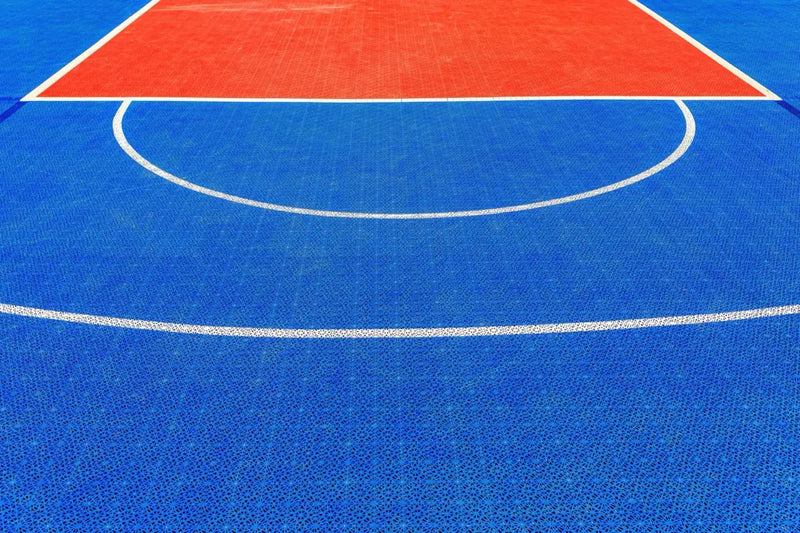
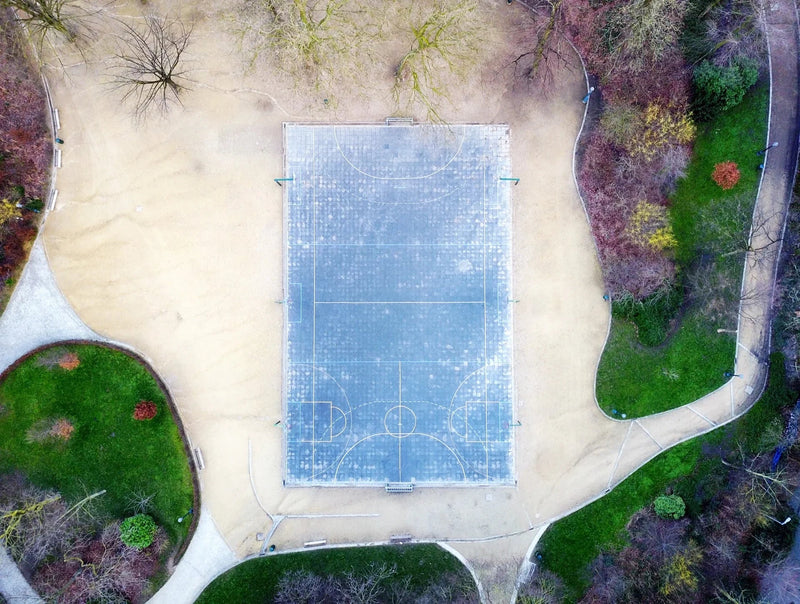
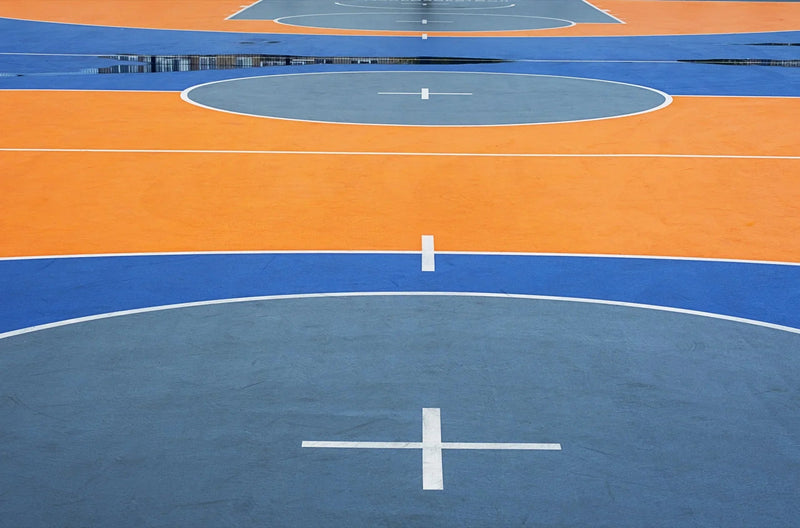
Real installations across India — schools, societies, academies, and corporate facilities.
Why ChampCourts
We're the installer, not just a material supplier.
Turnkey, not just supply
Site prep, base, surface, lines, equipment — we handle everything end-to-end.
Warranty you can rely on
3 to 5 year warranty on surface + workmanship. Documented and enforceable.
Pan-India service
Northeast to Bangalore — we travel where you build.
Transparent pricing
Real rates on every product page. No hidden cost, no surprises.
Frequently asked questions
Common questions about our court construction.
Most courts are built in 3-4 weeks from approval. PCC base needs 21 days to cure before surface application. Existing-base projects ship in 1-2 weeks.
Yes. We've installed courts from Arunachal Pradesh to Bangalore. Our team travels to your site for assessment and execution.
Site preparation, base construction (PCC or asphalt), surface installation, line marking, and basic equipment. Optional add-ons (fencing, lighting, nets) are quoted separately.
Acrylic courts: 2 years on coating + workmanship. PP tiles: 5 years. Vinyl: 5 years. Base construction: 5 years against structural failure.
Yes. We are a registered private limited company (CIN: U43299TS2026PTC213781) with GSTIN 36AANCC6975A1ZG. All invoices are GST-compliant.
Supply + Install: 50% advance on PI signing, 40% on material dispatch, 10% at handover. Supply Only: 50% advance, 50% before dispatch.
Ready to build your court?
Free site assessment within 48 hours. No commitment.
Prefer to call or WhatsApp?