

Get a free estimate for yourCOURT
Badminton Court Resurfacing & Renovation Services
Turnkey InstallationTurnkey court construction, transparent pricing, and a free written quotation. Pan-India service.
Configure your court
Prices are indicative per sqft, ex-GST. Use the cost calculator below for a full project estimate including base, kerbs, line marking, and add-ons.
Calculate Your Court Cost
Pre-configured for this surface. Enter dimensions for an instant estimate — no signup required.
Which sport will this court be used for?
How many courts and what configuration?
What surface type do you want?
What is the base / sub-structure situation?
Any add-ons? (Optional — all can be added later)
Indicative range only. Actual pricing depends on site conditions, geography, and final material availability. Use the WhatsApp button to send your configuration directly to our team for a detailed estimate within 5 minutes.
Is this surface right for you?
Best for
- Schools
- Society
- Academies
- Corporate
- Pay and play
- Tournament halls
Note
This surface is acceptable but not recommended for:
- Structurally failed slabs
Talk to us — we'll honestly advise the right fit for your goals.
Our recommendations draw on each sport's court dimensions and line-marking rules and on the team's 16+ years of hands-on experience. No surface is one-size-fits-all — we'd rather lose a sale than build the wrong court.
Badminton court resurfacing restores a worn or faded court: we survey and adhesion-test the existing surface first, treat every crack, alkali-seal prime, then lay an acrylic resurfacer, colour coats and fresh 40 mm BWF lines. Work is scheduled to dry-weather windows — typically November to May — and never quoted over an unknown substrate.
- Survey first: moisture check and cross-hatch adhesion test before any quote — no exceptions
- Crack law: active cracks get an elastomeric crack-isolation membrane; static cracks are sealed, sanded and primed
- Weather window: no application within 48 hours of rain or during monsoon; November–May is the working season
- Priced per square foot: colour refresh, full recoat, or crack-isolation system — the survey decides which
- Regulation finish: 40 mm lines re-marked to BWF spec on every recoat
- Indicative range: Rs 70–160+/sqft ex-GST depending on court condition
Updated August 2026 · Indicative ranges, ex-GST · exact rates confirmed only after the on-site survey

What a court renovation actually rebuilds — the resurfacing stack
A resurfacing job is not "a coat of paint" — it is a short, ordered stack of interventions, and the order separates a court that plays true for years from one that blisters in a monsoon. Every renovation is built from the layers below. Weighing a recoat against a new surface? The badminton flooring comparison guide compares acrylic, synthetic and wooden systems first.
| Layer | What goes in | Specification | Why it matters |
|---|---|---|---|
| Survey | Condition, moisture and adhesion testing | Field-sampled coat thickness; cross-hatch adhesion test mandatory | No quote over an unknown substrate — this is Law 1 |
| Repair | Crack treatment | Active cracks: elastomeric crack-isolation membrane; static cracks: PU seal-fill, sand, prime | Cracks telegraph straight through fresh paint — treat the cause before the colour (Law 3) |
| Priming | Alkali-seal primer | Applied to the prepared, cleaned substrate | Blocks alkali attack that would otherwise lift the acrylic coats (Law 2) |
| Resurfacer | Acrylic resurfacer coat(s) | Cement-free formulation — never cement in a resurfacer | Levels texture and rebuilds the wearing base without saponification (Law 2) |
| Colour | Acrylic colour coats | Acrylic only; dry-film biocide added for coastal or high-humidity sites | The playing surface plus a UV shield (Laws 2 and 5) |
| Marking | Fresh court lines | 40 mm width to BWF spec, contrasting colour | Regulation-accurate singles and doubles play |
| Scheduling | Weather-window execution | No application within 48 h of rain or during monsoon; November–May window | Cure quality is weather-bound — cutting this corner is how coats fail (Law 4) |
| Service | Handover + AMC option | Walkthrough, care guide, AMC tiers (Essential / Standard / Premium SLA) | Keeps the renewed court renewed |
What's NOT included: substrate reconstruction (if the survey fails the slab), drainage correction, and equipment replacement (nets, posts, fencing, lighting) are itemised separately. GST 18% extra on everything above.
What badminton court resurfacing costs
Resurfacing is priced per square foot: the real cost driver is your court's condition, not its size. The survey sorts every court into one of three treatment bands, published openly. For a new-court budget instead, see the badminton court construction cost guide.
| Treatment band | Rate (ex-GST) | When it applies | ~1,300 sqft court |
|---|---|---|---|
| Colour refresh | Rs 70/sqft | Surface is structurally sound; only faded colour and worn lines | ~Rs 0.9 lakh |
| Full recoat | Rs 90–120/sqft | Worn wearing course needs resurfacer rebuild before colour | ~Rs 1.2–1.6 lakh |
| Crack-isolation system | Rs 160+/sqft | Active cracking needs an elastomeric membrane before colour | Rs 2.1 lakh+ |
The per-court column uses a typical 1,300 sqft badminton footprint (52 × 25 ft with run-off); larger and multi-court venues scale proportionally — a tennis-court-class surface runs roughly Rs 4.5 lakh (refresh), Rs 6.5–8.5 lakh (full recoat) and Rs 11 lakh+ (crack-isolation). Standalone line marking is Rs 5,000 single-sport and Rs 5,000 per sport for multi-sport overlays.
Why the price spread exists — and why the survey precedes the quote
The gap between Rs 70 and Rs 160+ per square foot is not a margin dial — it is the substrate talking. A court that only lost colour needs coats; a delaminating course needs a resurfacer rebuild; live cracks need a flexible membrane first. Nobody can tell which you own from a photograph, which is why we test moisture and pull an adhesion sample before quoting — a figure quoted sight-unseen is a guess the owner pays for when the coats lift. Every band includes the survey, prep, the coats your court needs, fresh BWF lines and a photo-documented handover; GST 18% extra.
The Five Laws of an honest court renovation
Most resurfacing complaints in India trace back to the same shortcuts: a quote over an unseen slab, cement in a colour coat, cracks painted over, work rushed ahead of rain. We renovate to five fixed rules and would rather lose a quick job than break them.
Law 1 — Survey first. No quote over an unknown substrate.
Before we price anything, we visit the court, sample the coat thickness, run a moisture check and pull a mandatory cross-hatch adhesion test — it tells us whether the old surface will hold a new one at all. If it fails, no fresh acrylic will save the court, and we say so even when it costs us the job.
Law 2 — Chemistry is not negotiable.
We never put cement into a resurfacer or colour coat — in an acrylic wet film it drives saponification and the surface fails from within. The prepared substrate is alkali-seal primed so alkali cannot attack the acrylic from below, colour coats are acrylic only, and we never lay a polyurethane top without a polyurethane primer beneath it. These rules decide whether your court is still playing in year five.
Law 3 — Cracks are treated by cause, before any colour.
Cracks are sorted into active and static. Active cracks — the ones that move with temperature and load — receive an elastomeric crack-isolation membrane that absorbs movement so the crack cannot telegraph through the new surface. Static cracks are PU seal-filled, sanded flush and primed. Painting over a live crack is the commonest failure we inspect — the crack always wins.
Law 4 — Weather governs the calendar.
Acrylic coats are water-based and cure by evaporation, so they are weather-bound: no coat within 48 hours of forecast rain, and none during the monsoon. The reliable window across most of India is November to May, and we monitor IMD forecasts before each application day, because a court coated in the wrong week blisters six weeks later.
Law 5 — Coastal and high-humidity courts get biocide protection.
On coastal and persistently humid sites, we add a dry-film biocide to the colour coat to resist the algae and fungal growth that turns a fresh surface slippery and green within a season — a small addition at mixing, a large difference over the court's life.
Refresh, recoat, renovate or rebuild? A decision matrix
Not every tired court needs the same treatment, and the cheapest honest option is often not the one owners expect. The matrix below shows how to read your court before the survey confirms it.
| Option | Court age & state | Wear pattern | What we do |
|---|---|---|---|
| Colour refresh | 3–5 yrs; surface sound, colour faded | Even fade, worn lines, no cracking or delamination | Clean, one or two colour coats, re-mark lines |
| Full recoat | 5–8 yrs; wearing course thin or patchy | Bald patches, texture loss, minor static cracks | Crack seal-fill, resurfacer rebuild, colour coats, lines |
| Full renovation | 8+ yrs; active cracking present | Moving cracks, ponding, edge lift | Crack-isolation membrane, resurfacer, colour, lines |
| Rebuild (not resurfacing) | Any age; substrate failed the survey | Slab heave, deep structural cracks, drainage failure | New base required — resurfacing cannot save it |
The last row matters most. When the adhesion test or level survey shows the slab itself has failed, resurfacing is good money after bad — the answer is a new base, and we say so rather than sell coats guaranteed to lift. If a rebuild is on the table, a fresh PVC mat court or a wooden sprung floor often costs less over ten years than renovating a dying slab.


How long a renovation lasts — recoat cycle, AMC and warranty
A correctly executed acrylic resurfacing gives a working life in the 5–7 year class before the next colour recoat. Because the base survives each cycle, the second and third recoats are refresh-band jobs, materially cheaper than the first. Upkeep between recoats is light but not optional — we run two maintenance tiers by surface type:
- Acrylic surfaces — 2 visits per year. Deep clean, colour and line-wear inspection, crack watch, and touch-up of early hairline movement before it spreads.
- Badminton mats — quarterly. If your renovation is a PVC mat rather than acrylic, seams and edges are inspected four times a year — the mat-specific failure risk.
We warrant the acrylic system we lay — the workmanship and coating for its stated term — not a pre-existing substrate that later moves, which is precisely why Law 1 exists.
Three ways to renovate a court — honestly compared
There are a few realistic buying paths for a badminton court renovation, each carrying very different risk.
| Buying path | What you get | Where it bites |
|---|---|---|
| Local unbranded painter recoat | The lowest headline quote, a fast turnaround | Paint goes over dirt, cracks and unknown substrate — the recoat typically fails within a season, with no survey, crack treatment or warranty |
| Material-only supplier + your labour | Genuine acrylic material at a competitive per-litre price | Coverage rates, primer chemistry, crack calls and weather timing all fall on you; a wrong call wastes the whole material spend |
| DIY tile or coat over the old court | Weekend control, no contractor | Without adhesion testing and crack isolation, a surface over a compromised base lifts or cracks through, and the saving evaporates at the first re-do |
| Engineered resurfacing (survey-led) | Survey, crack treatment, correct chemistry, weather-timed coats, BWF lines, one written workmanship warranty | Costs more than a paint-over — you pay for the diagnostic and the disciplines that decide whether the court lasts one season or seven |
The rule from the courts we inspect is blunt: a paint-over fails in one season, while a survey-led renovation runs five to seven years.
Before and after — visualized, with specifications
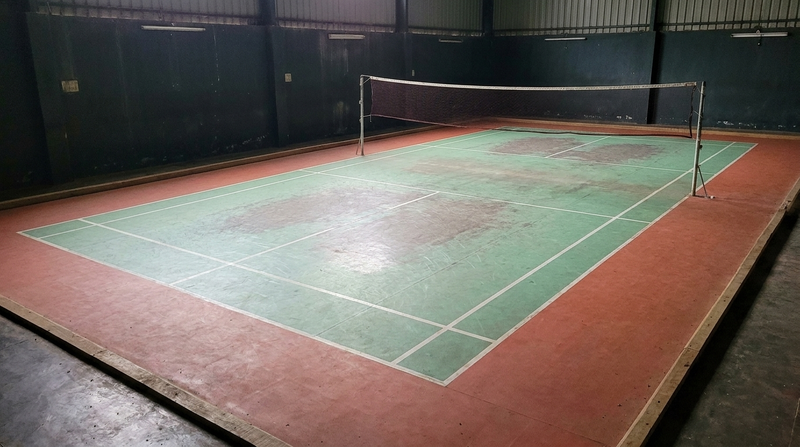
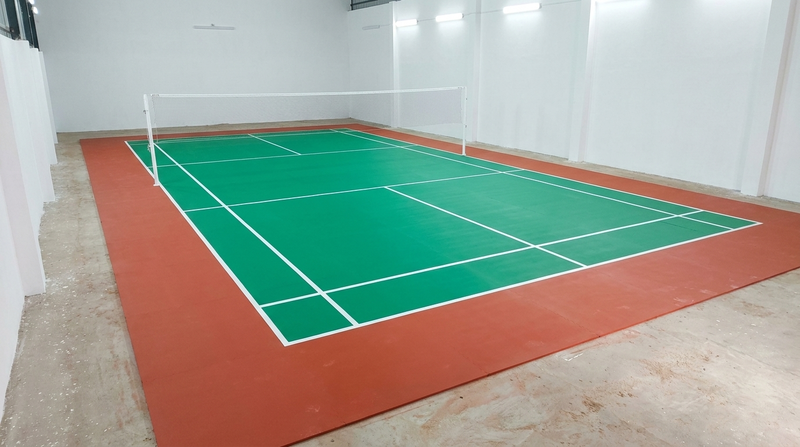
The illustration below shows the intended outcome — a freshly recoated, regulation-lined court — paired with the worn "before" state above. Visualized: the same court, before and after recoating.

| Parameter | Specification |
|---|---|
| Court core (BWF dimensions) | 44 × 20 ft (13.4 × 6.1 m); typical resurfacing footprint ~1,300 sqft (52 × 25 ft) with run-off |
| Coat system | Alkali-seal primer → acrylic resurfacer → acrylic colour coats → 40 mm lines |
| Crack treatment | Elastomeric membrane (active) / PU seal-fill + sand + prime (static) |
| Cure & recoat window | No application within 48 h of rain / monsoon; November–May working season |
| Line marking | 40 mm width to BWF spec, contrasting colour, re-marked on every recoat |
| Recoat cycle | 5–7 year class before next colour recoat, with two AMC visits/year |
Full court geometry, run-offs and marking plans are in the badminton court size and dimensions guide; for a city job, our Hyderabad badminton court services page covers local survey and scheduling. Ask us for the branded renovation spec sheet (PDF) — it carries this table plus the Five-Law survey checklist.
Frequently asked questions
When should a badminton court be resurfaced?
Resurface when the colour has faded and lines are worn but the surface is still sound — usually every 5–7 years for an acrylic court. Bring it forward if you see bald patches, texture loss, ponding after rain, or hairline cracking, as these signal the wearing course is failing. Once cracks start moving, delaying only pushes you from a recoat into a costlier crack-isolation renovation.
How much does badminton court resurfacing cost?
Resurfacing is priced per square foot: about Rs 70/sqft for a colour refresh, Rs 90–120/sqft for a full recoat, and Rs 160+/sqft for a crack-isolation system, ex-GST. A typical 1,300 sqft badminton court therefore lands near Rs 0.9 lakh, Rs 1.2–1.6 lakh, or Rs 2.1 lakh+ respectively. The exact band is set by the on-site survey, because court condition — not size — drives the price. GST 18% extra.
Can you just paint over an old court surface?
No — painting over a dirty, cracked or delaminating surface fails within a season. A durable renovation needs the old surface cleaned, tested for adhesion and moisture, cracks treated by cause, and an alkali-seal primer before any colour. Skipping the survey and prep is the single most common reason resurfacing jobs blister, lift or crack through. Paint over dirt is a saving that disappears at the first re-do.
How are cracks in a court fixed before recoating?
Cracks are first classified as active or static. Active cracks, which move with temperature and load, receive an elastomeric crack-isolation membrane that absorbs movement so the crack cannot telegraph through the new surface. Static cracks are polyurethane seal-filled, sanded flush and primed. Only after cracks are treated by cause do we prime and coat — colour over a live crack always fails.
What is the best season for court resurfacing in India?
November to May is the reliable window across most of India. Acrylic coats are water-based and cure by evaporation, so we apply no coat within 48 hours of forecast rain and never during the monsoon. We monitor IMD forecasts before each application day. A court coated in the wrong week can look perfect on handover and then blister weeks later, so weather timing is treated as a hard rule, not a preference.
How long does resurfacing take, including curing?
A straightforward colour refresh takes a few working days; a full recoat or crack-isolation renovation runs longer because each coat must cure before the next. Acrylic coats are applied in sequence with cure gaps between them, and we schedule the whole job inside a dry-weather window. We confirm the exact timeline after the survey, since crack treatment and the number of resurfacer coats depend on the court's condition.
Do coastal courts need special treatment?
Yes. Coastal and persistently humid sites are prone to algae and fungal growth that turns a fresh surface slippery and green within a season. On these courts we add a dry-film biocide to the colour coat, a small addition at mixing that makes a large difference to the surface's life near the sea or in a wet climate. We flag this during the survey so it is built into the quote from the start.
Book your court survey
Tell us your city, the court's age and what you are seeing — fade, cracks, patches, ponding — and we will schedule a survey and return a written per-square-foot estimate in the correct band. Request a survey, message us on WhatsApp (+91 92587 75187), call 92587 75187, or write to enquiry@champcourts.com.
ChampCourts Private Limited · Hyderabad HQ, service pan-India · GSTIN 36AANCC6975A1ZG
How we build your court — 6 steps
From site survey to handover — transparent at every stage.
Site survey & assessment
Our team visits, measures, and assesses soil + drainage.
Design & material approval
You approve dimensions, colours, line plan, and add-ons.
Base preparation
M20 PCC with GSB 70mm sub-base, or surface preparation if base exists.
Surface installation
Apply surface per spec — acrylic coats, PP tiles snap-fit, vinyl welded seams.
Line marking & equipment
Court-specific lines marked to each sport's court dimensions and line-marking rules; nets, posts or hoops installed.
Handover & warranty
Final inspection, walkthrough, warranty + maintenance docs handed over.
Project gallery
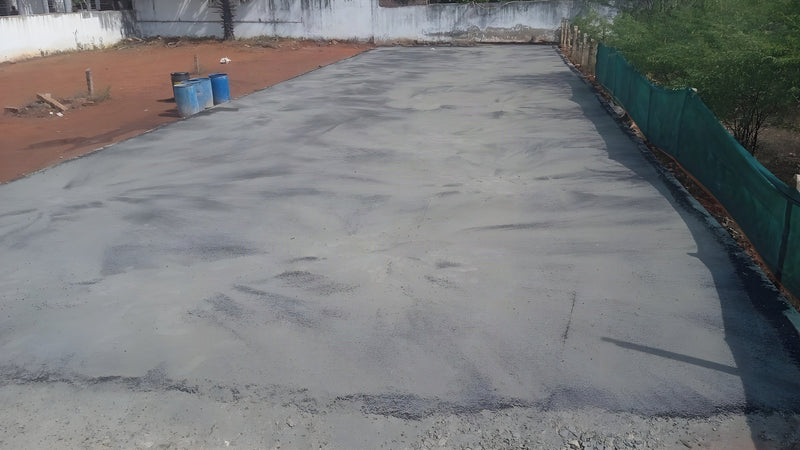
Real installations across India — schools, societies, academies, and corporate facilities.
Why ChampCourts
We're the installer, not just a material supplier.
Turnkey, not just supply
Site prep, base, surface, lines, equipment — we handle everything end-to-end.
Warranty you can rely on
Written limited warranty on surface and workmanship — terms on request. Documented and enforceable.
Pan-India service
Northeast to Bangalore — we travel where you build.
Transparent pricing
Real rates on every product page. No hidden cost, no surprises.
Frequently asked questions
Common questions about our court construction.
Resurface when the colour has faded and lines are worn but the surface is still sound — usually every 5-7 years for an acrylic court. Bring it forward if you see bald patches, texture loss, ponding after rain, or hairline cracking, as these signal the wearing course is failing. Once cracks start moving, delaying only pushes you from a recoat into a costlier crack-isolation renovation.
Resurfacing is priced per square foot: about Rs 70/sqft for a colour refresh, Rs 90-120/sqft for a full recoat, and Rs 160+/sqft for a crack-isolation system, ex-GST. A typical 1,300 sqft badminton court therefore lands near Rs 0.9 lakh, Rs 1.2-1.6 lakh, or Rs 2.1 lakh+ respectively. The exact band is set by the on-site survey, because court condition — not size — drives the price. GST 18% extra.
No — painting over a dirty, cracked or delaminating surface fails within a season. A durable renovation needs the old surface cleaned, tested for adhesion and moisture, cracks treated by cause, and an alkali-seal primer before any colour. Skipping the survey and prep is the single most common reason resurfacing jobs blister, lift or crack through. Paint over dirt is a saving that disappears at the first re-do.
Cracks are first classified as active or static. Active cracks, which move with temperature and load, receive an elastomeric crack-isolation membrane that absorbs movement so the crack cannot telegraph through the new surface. Static cracks are polyurethane seal-filled, sanded flush and primed. Only after cracks are treated by cause do we prime and coat — colour over a live crack always fails.
November to May is the reliable window across most of India. Acrylic coats are water-based and cure by evaporation, so we apply no coat within 48 hours of forecast rain and never during the monsoon. We monitor IMD forecasts before each application day. A court coated in the wrong week can look perfect on handover and then blister weeks later, so weather timing is treated as a hard rule, not a preference.
A straightforward colour refresh takes a few working days; a full recoat or crack-isolation renovation runs longer because each coat must cure before the next. Acrylic coats are applied in sequence with cure gaps between them, and we schedule the whole job inside a dry-weather window. We confirm the exact timeline after the survey, since crack treatment and the number of resurfacer coats depend on the court's condition.
Yes. Coastal and persistently humid sites are prone to algae and fungal growth that turns a fresh surface slippery and green within a season. On these courts we add a dry-film biocide to the colour coat, a small addition at mixing that makes a large difference to the surface's life near the sea or in a wet climate. We flag this during the survey so it is built into the quote from the start.
Ready to build your court?
Free written quotation. No commitment.
Prefer to call or WhatsApp?