

Get a free estimate for yourCOURT
Tennis Court — PP Interlocking Tiles (Recreational)
Turnkey InstallationTurnkey court construction, transparent pricing, and a free written quotation. Pan-India service.
Configure your court
Prices are indicative per sqft, ex-GST. Use the cost calculator below for a full project estimate including base, kerbs, line marking, and add-ons.
Calculate Your Court Cost
Pre-configured for this surface. Enter dimensions for an instant estimate — no signup required.
Which sport will this court be used for?
How many courts and what configuration?
What surface type do you want?
What is the base / sub-structure situation?
Any add-ons? (Optional — all can be added later)
Indicative range only. Actual pricing depends on site conditions, geography, and final material availability. Use the WhatsApp button to send your configuration directly to our team for a detailed estimate within 5 minutes.
Is this surface right for you?
Best for
- Recreational
- Schools
- Society
- Training
Note
This surface is acceptable but not recommended for:
- Tournament competition
Talk to us — we'll honestly advise the right fit for your goals.
Our recommendations draw on each sport's court dimensions and line-marking rules and on the team's 16+ years of hands-on experience. No surface is one-size-fits-all — we'd rather lose a sale than build the wrong court.
Overview
A polypropylene interlocking tile tennis court delivers a regulation ITF playing footprint at roughly half the cost of acrylic — making it the practical choice for residential societies, school sports blocks, club practice courts, and recreational venues. ChampCourts builds tennis courts on snap-fit PP tiles at ₹105–115 per sqft with a 5-year warranty and pan-India installation coverage. The surface is engineered for club-level play, junior coaching, and recreational singles or doubles where the budget will not stretch to a full 8-layer acrylic build. (Figures are indicative and vary by area, site condition and specification — request a free itemised estimate.)
Why does PP work for tennis? The lateral grid construction provides 3 to 5 per cent ball-speed reduction compared with acrylic — closer to a medium-pace surface, which is forgiving for amateurs and developing juniors. The tiles also drain rainwater within minutes through the grid, so monsoon downtime is dramatically reduced. For owners outside the tournament circuit, this combination of low cost, low maintenance, and weather resilience is hard to beat.
Specifications
| Parameter | Specification |
|---|---|
| Governing standard | International Tennis Federation (ITF) court dimensions |
| Singles court | 23.77 m x 8.23 m |
| Doubles court | 23.77 m x 10.97 m |
| Recommended run-off | 6.4 m behind baseline, 3.66 m on sides |
| Total fenced area | 36.6 m x 18.3 m (recommended) |
| Tile material | Virgin polypropylene, UV-stabilised |
| Tile thickness | 12.7 mm to 15.8 mm |
| Surface pace classification | Medium (ITF Pace Rating equivalent: 30 to 35) |
| Drainage | Through-tile grid drainage |
| Lifespan | 3 to 5 years |
| Warranty | 5 years |
Cost Breakdown
An ITF doubles court with run-off covers roughly 670 sqm (7,200 sqft). Pricing for a turnkey project:
| Component | Rate | Notes |
|---|---|---|
| PP interlocking tiles (supply + install) | ₹105–115 per sqft | Lines included |
| PCC sub-base | Rs 90 per sqft | If no existing slab |
| Net posts + net | Rs 18,000 to Rs 35,000 | ITF-spec set |
| Fencing (4 m chain-link, polyester-coated) | Rs 300 to Rs 450 per running ft | Recommended |
| LED floodlights (8 nos, 200 W) | Rs 1,40,000 to Rs 2,40,000 | For evening play |
An all-in club-grade tennis court on PP tiles, with PCC, fencing, lights, and net, lands between Rs 9 lakh and Rs 12 lakh — versus Rs 14 lakh to Rs 18 lakh for an acrylic equivalent.
Why PP Tiles for Tennis
PP tiles work for tennis when three conditions are met: (1) play is recreational or club level, not ITF-sanctioned; (2) the owner values fast monsoon recovery; (3) the budget needs to come in under Rs 12 lakh for the full court. The medium-pace bounce flatters amateur play, the cushion reduces joint fatigue during long sessions, and the modular surface allows partial repair without resurfacing the whole court.
Comparison vs Alternatives
| Surface | Rate | Lifespan | Pace | Best for |
|---|---|---|---|---|
| PP tiles | ₹105–115 per sqft | 3 to 5 yrs | Medium | Club, school, society |
| 8-layer acrylic | Rs 155 per sqft | 7 to 10 yrs | Medium-fast | Academy, tournament |
| Cushioned acrylic | Rs 180 to Rs 220 per sqft | 10+ yrs | Medium-fast | Premium club |
| Clay (red shale) | Rs 100 to Rs 130 per sqft | Annual top-up | Slow | European-style training |
Construction Process
- Site survey: confirm dimensions, slope, drainage.
- Excavation and PCC sub-base laying at 1-in-100 slope.
- 21-day concrete cure.
- Tile colour layout and ITF line marking plan.
- Snap-fit tile installation (3 to 4 days).
- Net post foundations and net rigging.
- Fencing erection.
- LED floodlight commissioning.
- 5-year warranty registration and care handover.
Use Cases
- Residential apartment complexes (10+ floor towers with podium courts)
- K-12 schools and CBSE/ICSE campuses
- Club practice courts (alongside primary acrylic match courts)
- Tennis academies' junior development zones
- Hotel and resort recreation facilities
FAQ
Q: Is a PP tennis court ITF-approved?
The dimensions follow ITF specifications, but PP tiles are not on the ITF Approved Court Surfaces list. For sanctioned tournaments, choose our acrylic tennis court.
Q: How does the bounce compare with hard court?
Slightly softer, 3 to 5 per cent slower. Many coaches actually prefer this for junior development because it lengthens rallies.
Q: Will the tiles get hot in summer?
UV-stabilised PP runs 8 to 10 deg C cooler than asphalt under the same sun, comparable to acrylic.
Q: Can I convert a PP court to acrylic later?
Yes. The PP tiles can be lifted, the slab can be levelled if needed, and an 8-layer acrylic system can be applied on the same sub-base.
Q: What is the maintenance routine?
Sweep weekly, pressure-wash quarterly, and inspect for cracked tiles annually. Replacement tiles are stocked.
Detailed Sub-base Engineering
Tennis demands a more rigorous sub-base than most sports because the lateral movement during baseline rallies stresses every square foot of the court. Our recommended sub-base specification is M25-grade concrete at 100 mm depth, reinforced with 8 mm steel mesh at 150 mm centres, finished with a steel trowel to a flatness tolerance of 3 mm in 3 m. The cross-slope must be exactly 1-in-100 along one axis (typically baseline-to-baseline). Any twin-slope or cross-slope variation causes ball-bounce inconsistency that frustrates serious players.
For rooftop or podium installations, the additional weight of the tile system (roughly 4 kg per sqm tiles plus 250 kg per sqm slab) needs structural verification. We routinely work with project structural consultants to verify the slab can carry an additional 250 to 300 kg per sqm dead load plus 200 kg per sqm live load. For weak or unverified slabs, a lightweight steel-frame deck with PP tiles is an alternative that drops dead load to 60 kg per sqm.
Performance Comparison vs Acrylic
| Metric | PP tiles | 8-layer acrylic |
|---|---|---|
| Ball pace (ITF Pace Rating) | 30 to 35 (Medium) | 40 to 45 (Medium-Fast) |
| Ball rebound height (from 2.54 m drop) | 1.15 to 1.20 m | 1.20 to 1.25 m |
| Force reduction | 15 to 22 per cent | less than 5 per cent |
| Surface friction | 0.6 to 0.7 | 0.65 to 0.75 |
| Recovery after rainfall | 5 to 10 minutes | 30 to 90 minutes |
| Lifespan | 3 to 5 yrs | 7 to 10 yrs |
| Annual maintenance cost | Rs 5,000 to Rs 8,000 | Rs 8,000 to Rs 15,000 |
The bottom line: PP gives you a club-grade surface at 45 per cent of the acrylic cost with similar playing experience for amateurs, but loses on lifespan and tournament-eligibility.
Lighting Design for Tennis
Tennis requires uniform horizontal illuminance with minimal glare for both daytime and evening play. ITF lighting recommendations are 300 lux for recreational play, 500 lux for club and academy play, and 750 to 1000 lux for tournament play. Our standard 8 x 200 W LED installation delivers 450 to 550 lux at court-centre with 0.7 uniformity ratio — suitable for any non-televised play. Pole height is 6 to 8 metres to keep glare angles outside the player's sightline during overhead serves.
Acoustic and Ball-Containment Design
Wind screens serve two purposes on outdoor tennis courts: they break wind that disturbs ball trajectory, and they provide a visual backdrop that helps players track the ball against a clean background. We use 3 m HDPE wind-screen panels in dark green (closest to professional tournament backdrop), rated for 95 per cent wind block and 8-year UV resistance. The 4 m chain-link perimeter fence contains errant balls and prevents intruders from disrupting play.
Real Project Reference
A boutique tennis academy in north Bangalore installed two PP-tile tennis courts in March 2026 to expand its junior development programme. The choice of PP over acrylic was driven by capex constraints — the academy wanted to bring on 40 additional juniors without raising fees. Total project cost (2 courts, fenced, lit, with nets): Rs 21 lakh. Player feedback after 3 months: amateurs report no perceptible difference from the existing acrylic match courts; coaches note slightly longer rallies which helps drill structure. Monsoon downtime in the first June rains: 8 minutes average post-shower (vs ~45 minutes on acrylic).
Additional FAQ
Q: How does a PP tennis court compare with red clay?
PP tiles are medium-pace with consistent bounce; red clay is slow-pace with high topspin response. PP needs zero daily upkeep; clay needs daily watering, rolling, and line-marking. For coaching consistency PP wins; for European-style baseline training clay wins.
Q: Can I use my existing tennis nets and posts?
Yes, provided the post mounting is compatible. We can either drop the existing posts into new floor sleeves or supply matching new posts at Rs 18,000 to Rs 35,000 per set.
Q: Will my coach be able to call lines accurately?
Yes. Pre-coloured tile lines are 50 mm wide white on a contrasting playing-area colour — fully ITF-line compliant in dimensions, only the surface material differs from acrylic.
Q: What about my elbow and shoulder injuries from hard court?
The 15 to 22 per cent force reduction on PP tiles measurably lowers impact transmission to the upper kinetic chain. Players with chronic elbow issues commonly report relief within 4 to 6 weeks of switching from acrylic to PP.
Q: Can the same court host pickleball?
Yes. Pickleball overlays inside a tennis singles court are popular. Add pickleball lines at Rs 8 per sqft additional.
Whether you are upgrading a society court, expanding an academy programme, or building a private home court, our team will guide you through tile selection, sub-base design, equipment specification, and post-installation care. Every project starts with a free no-obligation site survey. Call +91 92587 75187 or use our contact form for a free site survey. See also: acrylic tennis court, cushioned acrylic tennis court.
How we build your court — 6 steps
From site survey to handover — transparent at every stage.
Site survey & assessment
Our team visits, measures, and assesses soil + drainage.
Design & material approval
You approve dimensions, colours, line plan, and add-ons.
Base preparation
M20 PCC with GSB 70mm sub-base, or surface preparation if base exists.
Surface installation
Apply surface per spec — acrylic coats, PP tiles snap-fit, vinyl welded seams.
Line marking & equipment
Court-specific lines marked to each sport's court dimensions and line-marking rules; nets, posts or hoops installed.
Handover & warranty
Final inspection, walkthrough, warranty + maintenance docs handed over.
Project gallery
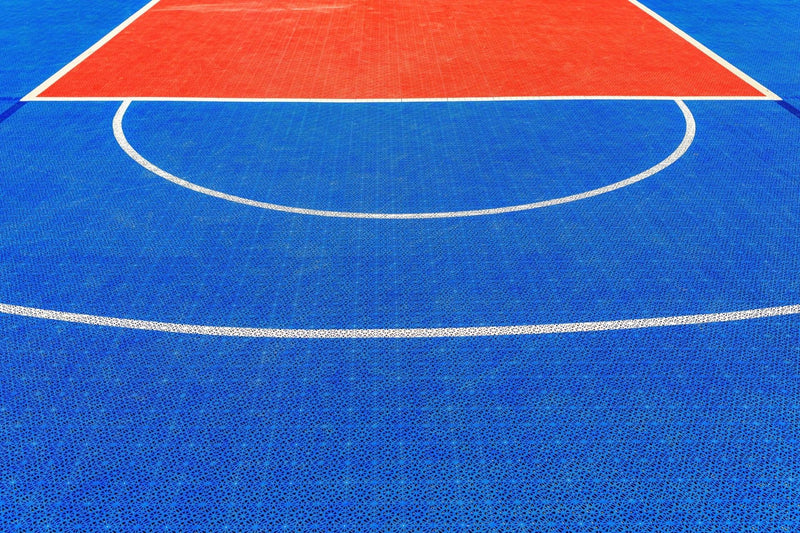
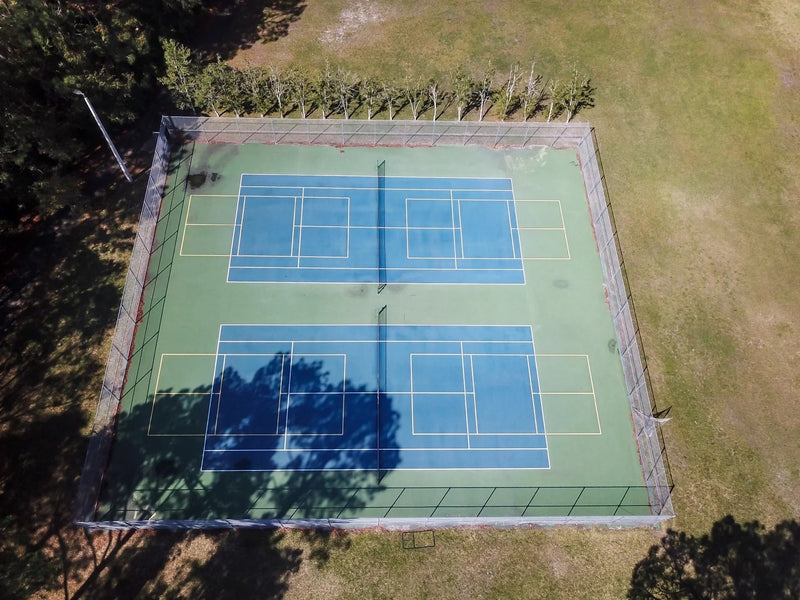
Real installations across India — schools, societies, academies, and corporate facilities.
Why ChampCourts
We're the installer, not just a material supplier.
Turnkey, not just supply
Site prep, base, surface, lines, equipment — we handle everything end-to-end.
Warranty you can rely on
Written limited warranty on surface and workmanship — terms on request. Documented and enforceable.
Pan-India service
Northeast to Bangalore — we travel where you build.
Transparent pricing
Real rates on every product page. No hidden cost, no surprises.
Frequently asked questions
Common questions about our court construction.
Most courts are built in 3-4 weeks from approval. PCC base needs 21 days to cure before surface application. Existing-base projects ship in 1-2 weeks.
Yes. We've installed courts from Arunachal Pradesh to Bangalore. Our team travels to your site for assessment and execution.
Site preparation, base construction (PCC or asphalt), surface installation, line marking, and basic equipment. Optional add-ons (fencing, lighting, nets) are quoted separately.
PP interlocking tiles: 5-year written limited warranty. Acrylic coating, vinyl, and base construction: written limited warranty on materials and workmanship — terms on request.
Yes. We are a registered private limited company (CIN: U43299TS2026PTC213781) with GSTIN 36AANCC6975A1ZG. All invoices are GST-compliant.
Supply + Install: 50% advance on PI signing, 40% on material dispatch, 10% at handover. Supply Only: 50% advance, 50% before dispatch.
Ready to build your court?
Free written quotation. No commitment.
Prefer to call or WhatsApp?