
On Day 1, before a single tile had arrived, we mounted a timelapse camera to a structural column at the north end of the space. Frame interval: fifteen minutes. Over the next 28 days, it recorded 7,800 square feet of empty ground-floor retail becoming a six-court badminton complex — tile by tile, court by court, from a bare concrete slab with exposed HVAC overhead to a fully lit, acoustically tuned, league-ready sports facility. Compressed to three minutes, it is one of the most satisfying construction sequences we have produced. The IT park uses it as a tenant presentation asset to this day.
Ground-floor commercial space in a Bengaluru IT park sounds like a straightforward asset. For this particular property, it had been a slow-burn problem for three years. The 7,800 square feet at the base of Building C had cycled through two food-court operators and a short-lived gym — each leaving a different fitout for the next tenant to gut. The park management had spent more on strip-outs than on any single fitout. By the time ChampCourts was contacted, the space had been sitting empty for eight months. The facilities manager was fielding weekly complaints from 12 companies whose combined 5,000-plus employees had nowhere meaningful to spend their lunch break. Then someone in a committee meeting said the word "badminton."
The word landed. Bengaluru is a badminton city in a way that is difficult to explain to someone who has not worked in its technology sector. Shuttle courts are the office sport the way squash was for a previous corporate generation. Across the park, four companies had internal badminton WhatsApp groups of over a hundred members each. The facilities manager ran a quick survey. 83% of respondents said they would use an on-campus badminton facility at least twice a week. The committee approved the project two weeks later.
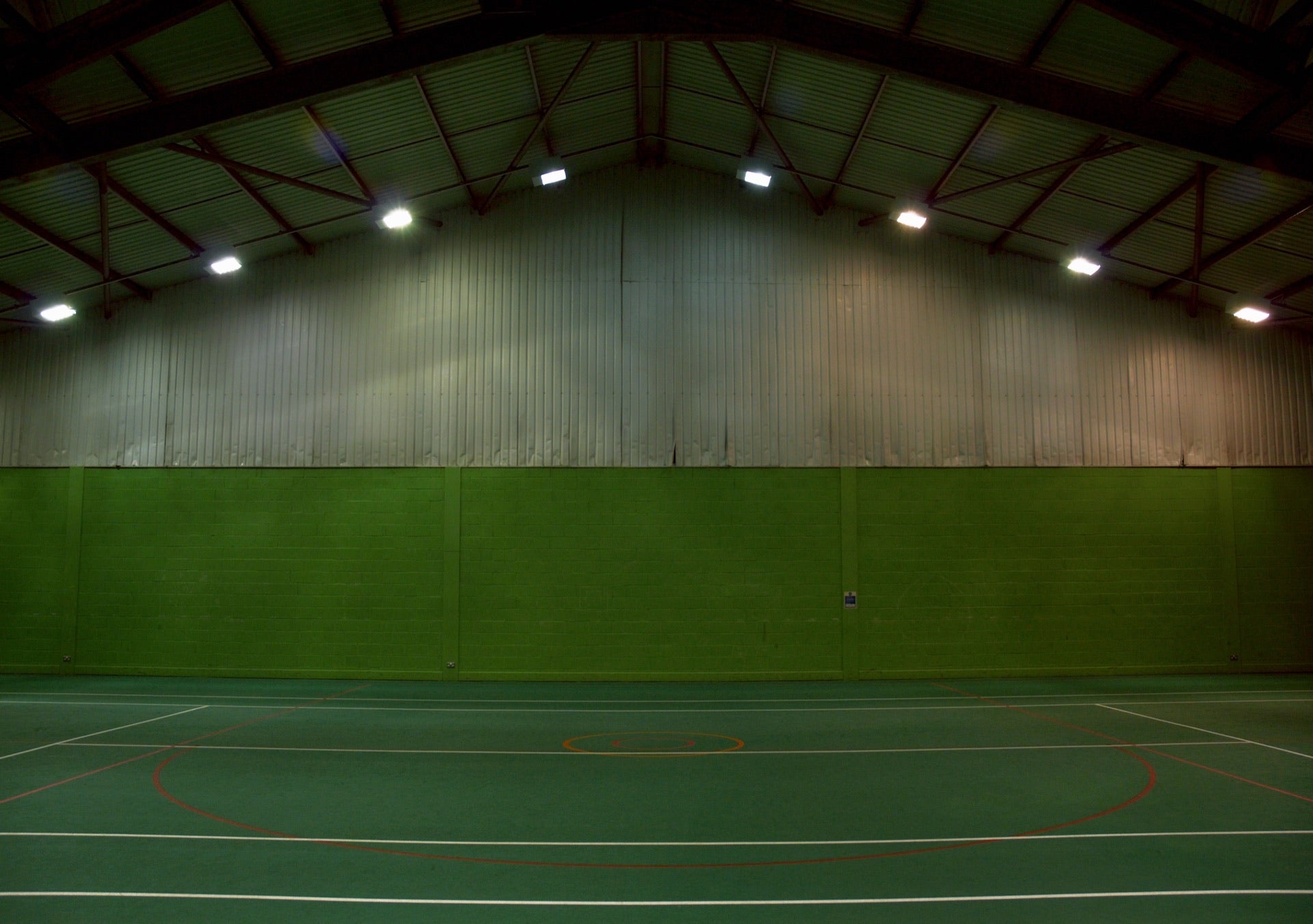
Converting commercial retail into a six-court badminton complex is not just a surface project. It is a building systems project that happens to include a surface. Three challenges had to be resolved before tile work could begin.
Ventilation. Badminton shuttlecocks are acutely sensitive to air movement — even a 1.5 m/s lateral draft is enough to make the shuttle behave unpredictably in flight. The existing HVAC was designed for retail comfort, with supply diffusers positioned for occupant coverage, not for controlling airflow at shuttle-flight height. The park's MEP consultant relocated supply diffusers to a high-level perimeter pattern and reduced supply velocity. Result: 24°C thermal comfort maintained without any lateral movement in the play zone.
Lighting. BWF competition standard requires 500 lux minimum at court level with a uniformity ratio of at least 0.6. The retail lighting delivered between 180 and 240 lux at floor level, with hotspots and shadow bands between fixtures. The park's electrical contractor installed 100W LED high-bay fittings at 8-metre centres — 520 lux average across all six courts at handover, uniformity ratio 0.75.
Acoustics. Six simultaneous badminton games in an enclosed space produce a specific and significant noise environment — shuttle impact, footwork, player calls. The empty retail shell measured 2.8 seconds reverberation time, which would have made game communication on adjacent courts very difficult. Ceiling acoustic baffles brought that figure to 1.1 seconds — comfortable for game communication without players having to shout.
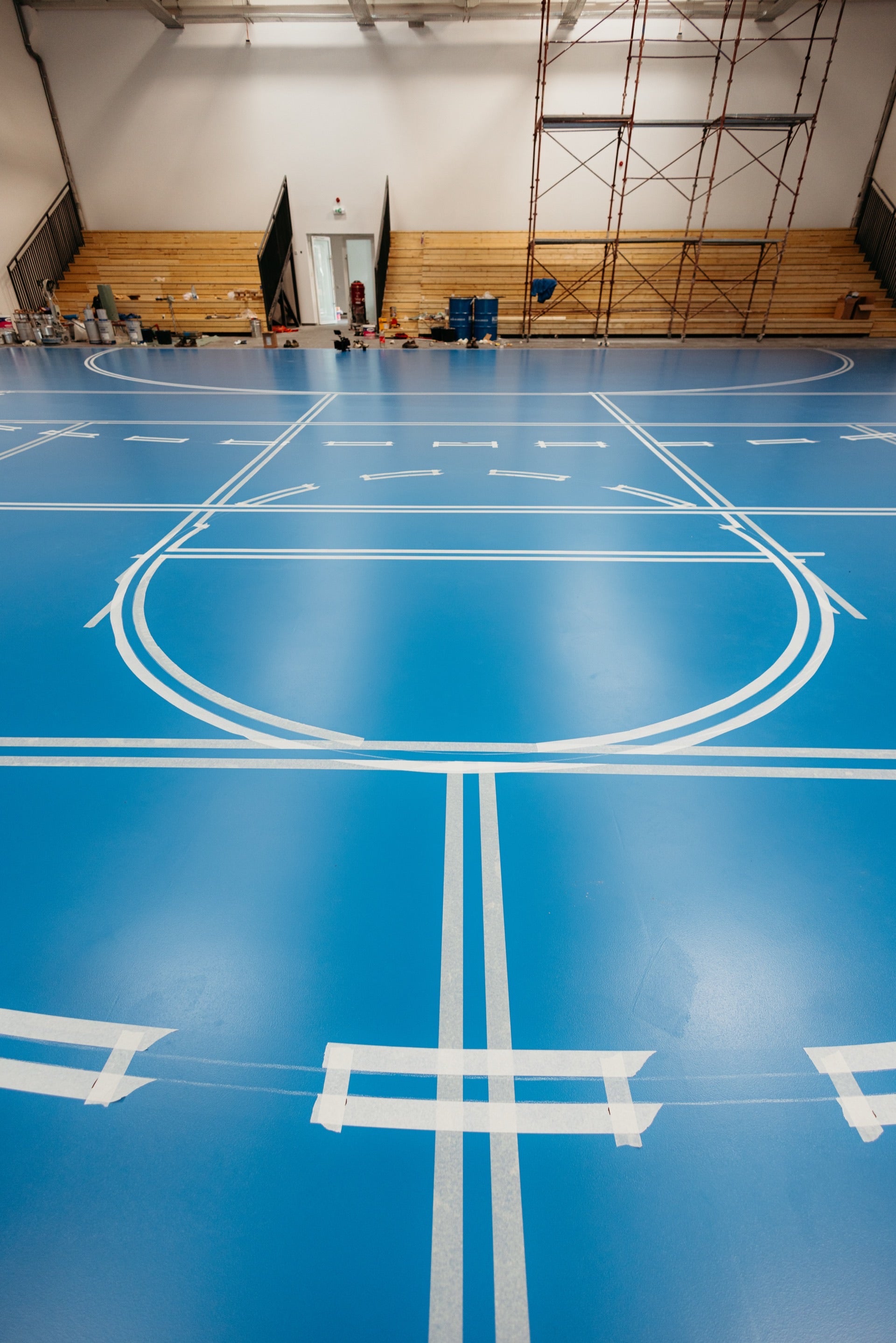
Six courts in a single enclosed space create a visual organisation problem. A uniform single-colour field of 7,800 square feet would be monotonous, and it would be hard to track from the gallery end which court a rally was happening on. The facilities manager came up with the colour-coding: Courts 1 and 2 in Blue, Courts 3 and 4 in Green, Courts 5 and 6 in Red. Each pair functions as a distinct visual zone, which also maps directly onto league organisation — teams in the Blue bracket, Green bracket, and Red bracket, using the court colour as the primary identifier for fixture scheduling.
It looks obvious after the fact. During the planning phase, it was the facilities manager's idea, proposed in a ten-minute meeting. We implemented it exactly as he described.
Each badminton court (52ft × 25ft) requires its own complete kerb perimeter: male kerbs = 52 + 25 = 77 pieces, female kerbs = 77 pieces, total per court = 154 kerb pieces + 4 corner pieces. Across six independent courts: 6 × 154 = 924 kerb pieces + 6 × 4 = 24 corner pieces. These are not shared perimeters — each court has its own complete kerb boundary, so any individual court can be isolated, inspected, or retiled without disturbing the courts beside it. At this scale, that independence is an operational requirement, not a preference.
The inter-company league started with eight teams. By the second season it had grown to twenty-four — two teams from each of the park's twelve companies. Saturday match days draw spectators from companies that have no team in that day's fixtures. The facilities manager has introduced a spectator queue for the finals. The same space that failed as a food court and a gym now operates with a waitlist.
Two new tenants — both technology companies who toured the park during lease negotiations — cited the badminton facility as a factor in their decision to sign. One HR director was direct: "When we are competing for talent with parks that have rooftop pools, having a proper six-court badminton complex is a genuine differentiator." The asset that sat empty for three years is now the most talked-about amenity in tenant conversations.
The facilities manager is now in discussion with the park committee about expanding into an adjacent space. Phase 2 is under consideration. The timelapse camera is still mounted to the same column. When the time comes, we know exactly how to set it up.
"We had tried every other use for that space. When we finally decided on badminton, it felt obvious — like we should have thought of it three years ago. The courts run at capacity every single day."
Bengaluru, Karnataka
Sport: Badminton (x6 Courts) | Surface: PP Interlocking Tiles | Client: Corporate IT Park